Origins and coverings
My dad's music came on 45s and an AM radio. Country. The Grand Ole Opry. Hee Haw.
My mom's soundtrack was oldies on 2WD and vinyl records, and later, afternoons watching Turner Classic Movies.
I grew up listening to twang, crooners, and orchestras long before I knew there were stations that played anything else. I grew up singing Elvira in a 68 Ford with no AC and vinyl seats that stuck to my thighs.
But I coveted my sister's little radio and when she ran off and left it behind, it became mine.
One evening I turned the dial and somehow landed on Z104.
The 1980s exploded in my ears.
Those songs became my songs.
I even got a Walkman and wore the headphones like they were a hairband, the foam earpieces giving me relief, blocking out the adult world, words, arguments, confusion. Giving me the radio and occasional pilfered tape from my sister’s house.
Some songs became my world. I got a boombox and recorded songs off the radio. I played some over and over writing the lyrics down with my best friend. Cyndy Lauper’s Time After Time our anthem. We dreamed of being stars. Being the artist, the writer, the songwriter.
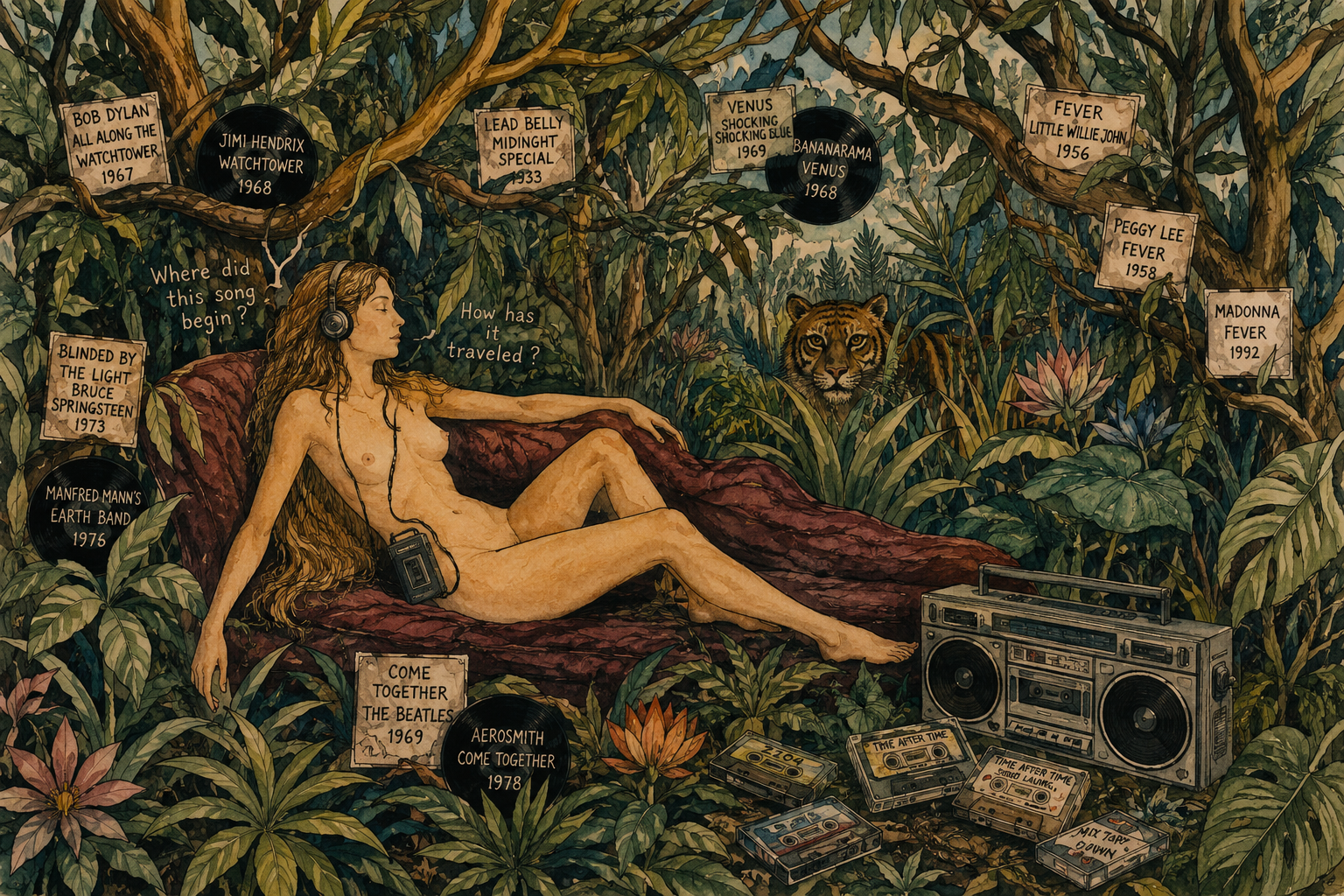
I assumed the people singing them had written them. It never occurred to me that Bananarama hadn't created Venus, or that Madonna wasn't the first voice behind Fever. Aerosmith was of course all original… HA! I was a teen of the Virginia Beach suburbs. I had no record store on the corner or a basement.
I was completely unaware. Babe in the woods.
There were no music history lessons in our house. Occasionally a van with an 8 track in our driveway. There was a television. There was a radio. There was a library that claimed authority over subjects I had no interest in. But as digital age overwhelmed me, I learned how to swing on vines and research questions I didn’t know to ask decades ago.
But every once in a while, a vine breaks, and I fall, tumble, in surprise, back down to the roots.
One vine, 40 years old, did just that. Snap. Boom.
I discovered Jimi Hendix hadn't written All Along the Watchtower. It was Bob Dylan’s. My beloved Jimi Hendrix had transformed a song written by Bob Dylan. Not copied it. Not stolen it. Transformed it.
So I started to go out on more limbs, follow then down to their roots. Where had songs I loved come from?
The more I looked, the stranger it became.
Sometimes the version I loved was a cover.
Sometimes the "original" I discovered wasn't the original at all.
It was another interpretation of a song that had already lived another life.
What on earth was going on?
Eventually I learned that, for much of popular music, songs and recordings were considered different things. Songwriters wrote compositions. Performers recorded interpretations. A great song wasn't necessarily expected to have only one voice. It could travel. It could evolve. It could gather new arrangements, new audiences, and even new meanings.
Then the 1990s arrived.
Suddenly the conversation seemed to change.
Sampling.
Copyright lawsuits.
Who owned the riff?
Who deserved the royalties?
Who had stolen from whom?
Music became filled with legal battles and headlines about ownership.
I despise conflict largely because i grew up in a volatile household. It doesn’t interest me. It turns me off.
But hose disputes for me became gateways and maps.
Every lawsuit and headline and dispute sent me back to a collaborative family tree.
People like myself were introduced to older artists. Some of us bought old albums, compared versions, and found themselves wandering through decades of music they might never have explored otherwise.
For me, songs have started behaving more like stories than possessions. Ironically, they've only fueled my desire to research, collect, and buy more vinyl. Sue me. Ha!
One voice begins a song.
Another voice answers.
Another voice reimagines.
Another younger generation mistakes the latest branch for the whole tree.
Until curiosity tugs on a vine.
Music can stop looking like isolated masterpieces and starts looking like a collaborative family tree.
A Few Vines I Swung
Song Songwriter / First Recording Version That Introduced It to Me
Venus Shocking Blue (1969) Bananarama (1986)
Fever Little Willie John (1956) (written by Eddie Cooley & Otis Blackwell under the name John Davenport) Peggy Lee (1958) Maddona (1980s)
All Along the Watchtower Bob Dylan (1967) Jimi Hendrix (1968)
Blinded by the Light Bruce Springsteen (1973) Manfred Mann's Earth Band (1976)
Come Together The Beatles (1969) Aerosmith (1978)
I suspect there are hundreds more hiding in my record collection.
Now, aware of how songs have been passed from one artist to another across generations, I find myself asking:
"Where did this song begin?"
"And how has it traveled?"
The Substance: A Study of Grandiose Consumptions
Consumption
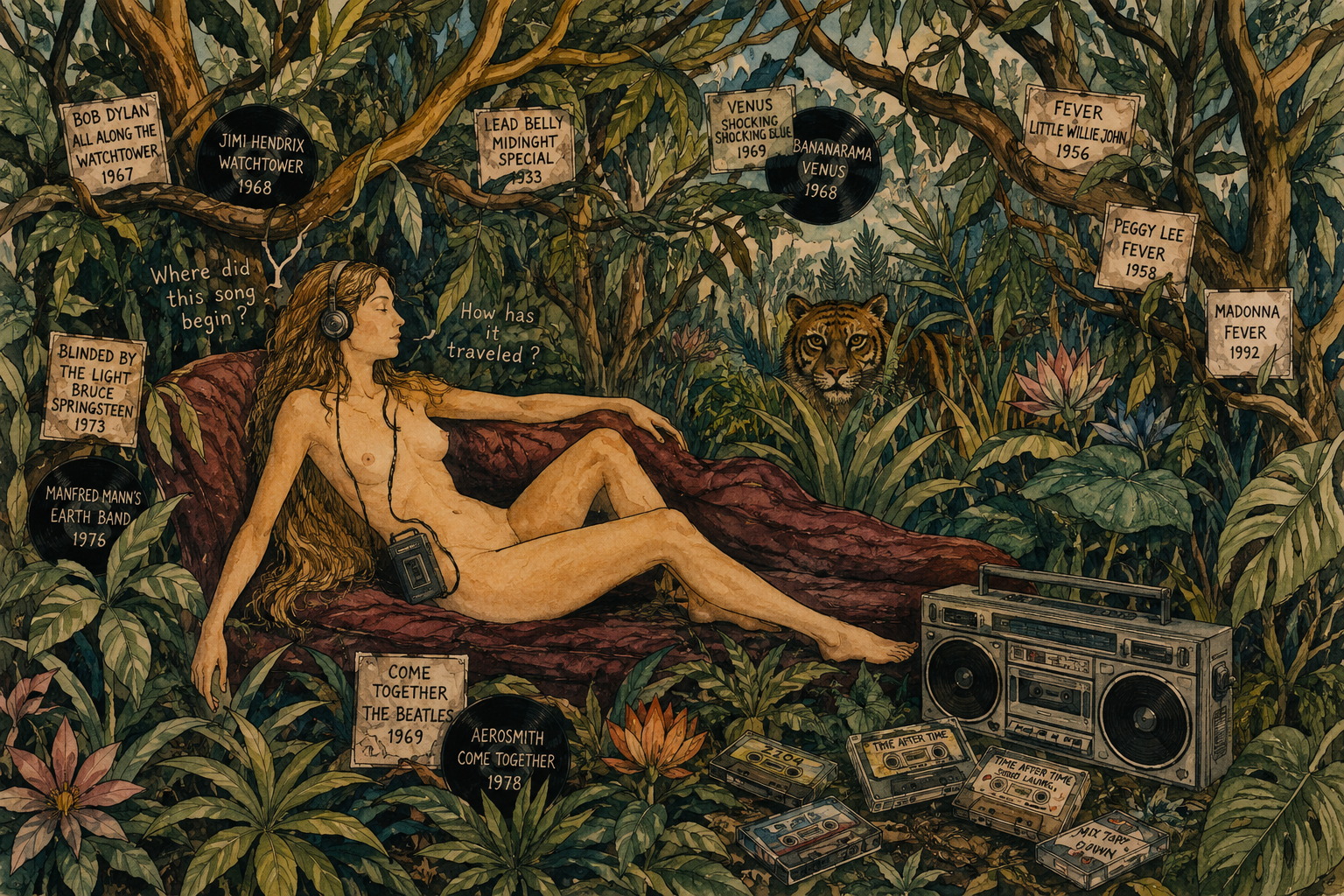
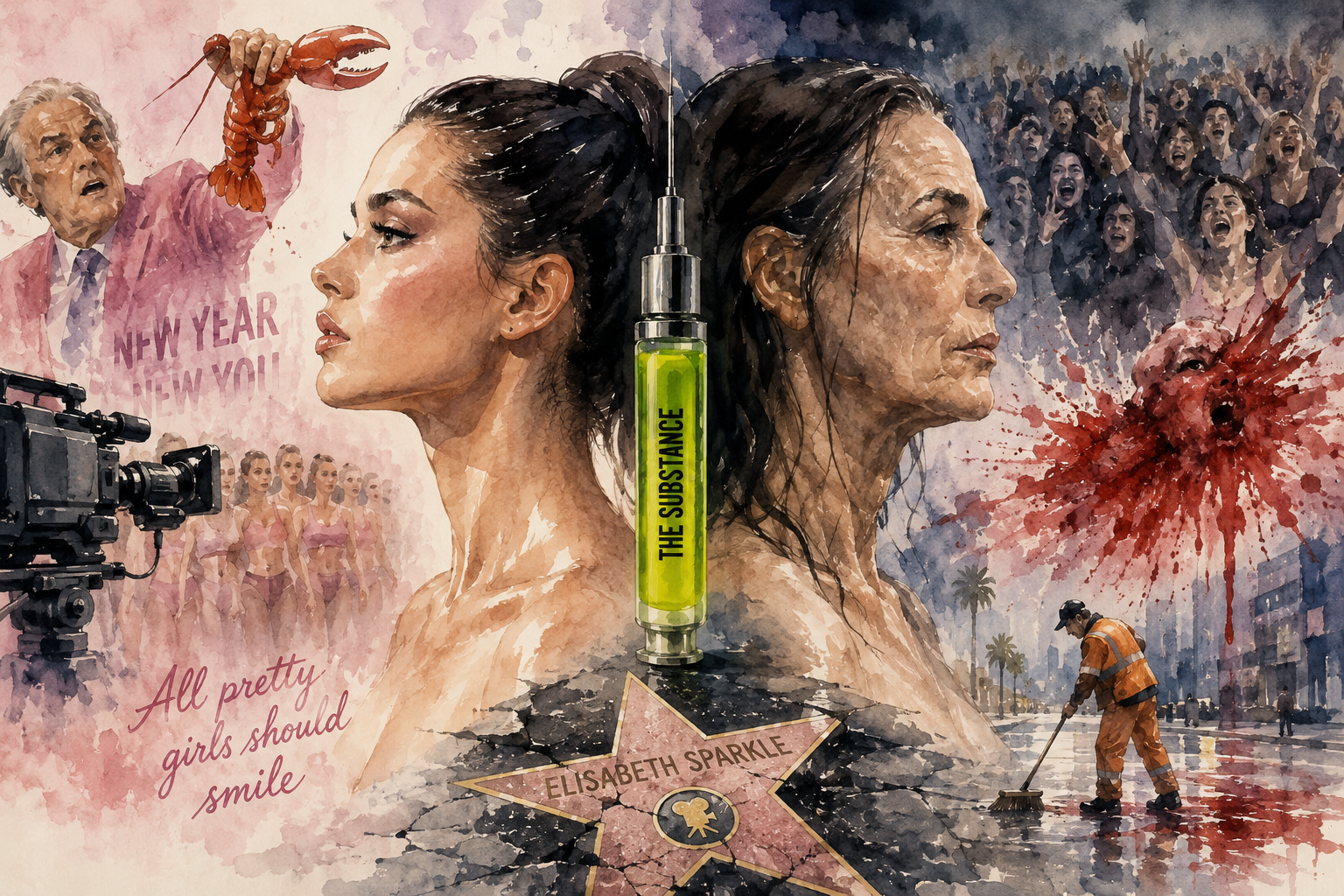
There is a moment while watching The Substance when I stopped asking what was happening to Elisabeth Sparkle and started asking what the film was doing to me.
At first, I thought the filmmakers simply didn't know when enough was enough.
Then I wondered if that was precisely the question they were asking the audience.
That shift changed the way I understood the film.
Most discussions of The Substance frame it as a satire about beauty standards, aging, and Hollywood. It is certainly those things. But I don't think beauty is its central concern. Beauty is simply the first imbalance. What the film ultimately explores is something much larger: a culture that has lost all sense of proportion.
A culture that has disregarded balance.
The premise is deceptively simple. Elisabeth Sparkle has built a career on being desirable. Let's not pretend the film is really about health, wellness, or even youth. It is about sex appeal—commodified, packaged, and sold.
Then she turns fifty.
The producer doesn't make this point with a thoughtful speech. He makes it while greedily tearing apart a seafood platter, gnashing through shellfish with almost animalistic enthusiasm. It is one of the film's first visual metaphors for appetite. Elisabeth watches him. She understands exactly what is happening. When he waves a limp crawdad in the air and says, "You know," many of us know exactly what he means.
She has lost her appeal.
Or, more precisely, she has reached the point where the industry believes she has topped out.
Being fifty myself, I almost laughed at the generosity. Depending on who you ask, Hollywood decided women were "over" at thirty... perhaps forty if they were lucky.
The tragedy isn't simply that Hollywood wants someone younger.
It's that Elisabeth doesn't want to leave.
Not yet.
Not ever.
Irreplaceable.
Like most of us, she doesn't want to disappear.
The film repeatedly reminds us that women are viewed in pieces rather than as whole people. The camera lingers on Sue's body the same way advertising does. Legs. Hips. Buttocks. Breasts. Slow motion. Fragmentation. The gaze itself becomes part of the story.
One of the film's most revealing moments comes when Sue suddenly demands a robe. She wants to cover herself. She finally experiences herself not as a woman preparing for work, but as an object assembled for someone else's visual consumption.
It is Elisabeth who still longs to hear the words every human being wants to hear.
We love you.
You are beautiful.
You could never be replaced.
That is different from wanting to be desired.
It is wanting to matter.
To be valued.
As Elisabeth creates Sue, the imbalance accelerates. It was always there, but now the film gives it a body.
Youth begins to hate age.
Age begins to hate youth.
The violence they inflict on one another becomes physical, but it represents something painfully recognizable: self-hatred born from impossible standards. Neither version can survive because each believes the other is stealing her life.
This is where the film's metaphor is at its strongest.
Then something curious happens.
The movie itself begins behaving like its own characters.
Every grotesque image is followed by something more grotesque.
Every mutation requires another mutation.
Every shocking moment demands something even bigger.
By the final act, I found myself wondering whether I had accidentally wandered into an entirely different movie. The ending carries the excess of the action films of the 1980s and 1990s, where body counts, explosions, and spectacle became competitions.
How many buckets of blood can we splatter?
The deformities become theatrical.
Whatever image the film introduces, it repeats, enlarges, and mutates until it becomes grotesque. Long before the detached breast hits the floor, I felt the metaphor had already landed.
I found myself asking what the filmmakers were doing.
(Okay... maybe it was more like, What the hell are they doing?!)
Then another possibility occurred to me.
Perhaps the film knows exactly what it is doing.
Perhaps it is asking the audience the same question it asks of Hollywood.
How much is enough?
How much beauty?
How much youth?
How much nudity?
How much gore?
How much spectacle?
At several points the movie feels as though it pauses, looks directly at the audience, and asks:
Still here?
Have I gone too far yet?
Did you get your ticket's worth?
If that is the intention, it is one of the film's cleverest ideas. It transforms the audience from observers into participants. We are no longer simply watching a story about consumption.
We are asked to examine our own appetite for excess.
The substance isn't merely the mysterious serum.
It is the substance of our desires.
The substance of entertainment.
The substance of celebrity.
The substance of consumption itself.
For me, the film made its point long before the gallons of blood. Yet I cannot dismiss the possibility that the excess is itself part of the argument. The film becomes as imbalanced as the world it depicts.
In the end, the monster dies.
Elisabeth's face crawls back to the Hollywood star that once bore her name. For a brief, almost heartbreaking moment, she imagines herself dusted in stardust rather than blood. She is loved. She belongs. She matters.
Morning comes.
A street cleaner washes her away.
The star remains.
Perhaps that is the final imbalance.
Hollywood preserves the symbol while erasing the person.
The performance survives.
The woman does not.
Please note, this is not a recommendation.
The only lasting thing I took from watching The Substance was the possibility that the filmmakers wanted us to finally reach a point where we turned away. To reject the spectacle. To decide that enough was enough.
If that was the experiment, it didn't work.
The film earned more than $80 million worldwide and received major awards recognition.
Or perhaps that, too, is part of the joke.
Even a film questioning our appetite for excess becomes another spectacle we consume.
I don’t think I really care for this version of Hollywood or entertainment. But I get the point. Perhaps I understand what film makers are trying to do. I just wish we didn’t live in a culture where this is the language we need to speak in order to be heard. Grotesque spectacle.
But it is the world we live in.
Curating Pressings and Prints
Curating
For some time now, I’ve wanted to curate a collection of vinyl, books, and art.
Not out of snobbery.
Not because I wanted the rarest editions or the most expensive shelves.
I wanted something intentional. Something I could have conversations about.
Someday, when my children stand in front of these shelves, I hope they don’t simply see things I accumulated. I hope they see a trail of curiosity. A record of questions. A collection built with care.
The problem was that I knew almost nothing.
How do you begin collecting something when you don’t know what matters?
I’ve been talked down to about art, music, and literature from two different directions—one elitist and the other supposedly grassroots.
In my experience, both voices were usually male. Condescending in different ways, but condescending all the same. It undermined my confidence more than I realized.
But regardless, I felt drawn to these things. I found myself asking the same questions over and over.
What do I want?
Why this artist?
Why this edition?
Why is one pressing twenty dollars while another is two hundred?
And perhaps the biggest question of all: Why does any of it matter?
For a while, the questions felt bigger than the collection.
Then, almost without noticing, a pattern emerged.
I wasn’t looking for popularity.
I wasn’t looking for obscurity either.
I wasn’t trying to own every classic album ever made.
I wasn’t trying to find something no one else had heard of.
I was looking for moments—and for what mattered to me personally.
Moments when an artist created something that shifted the conversation.
Moments that captured a season of culture.
Moments when someone was brave enough to make something unusual, ambitious, or beautifully strange.
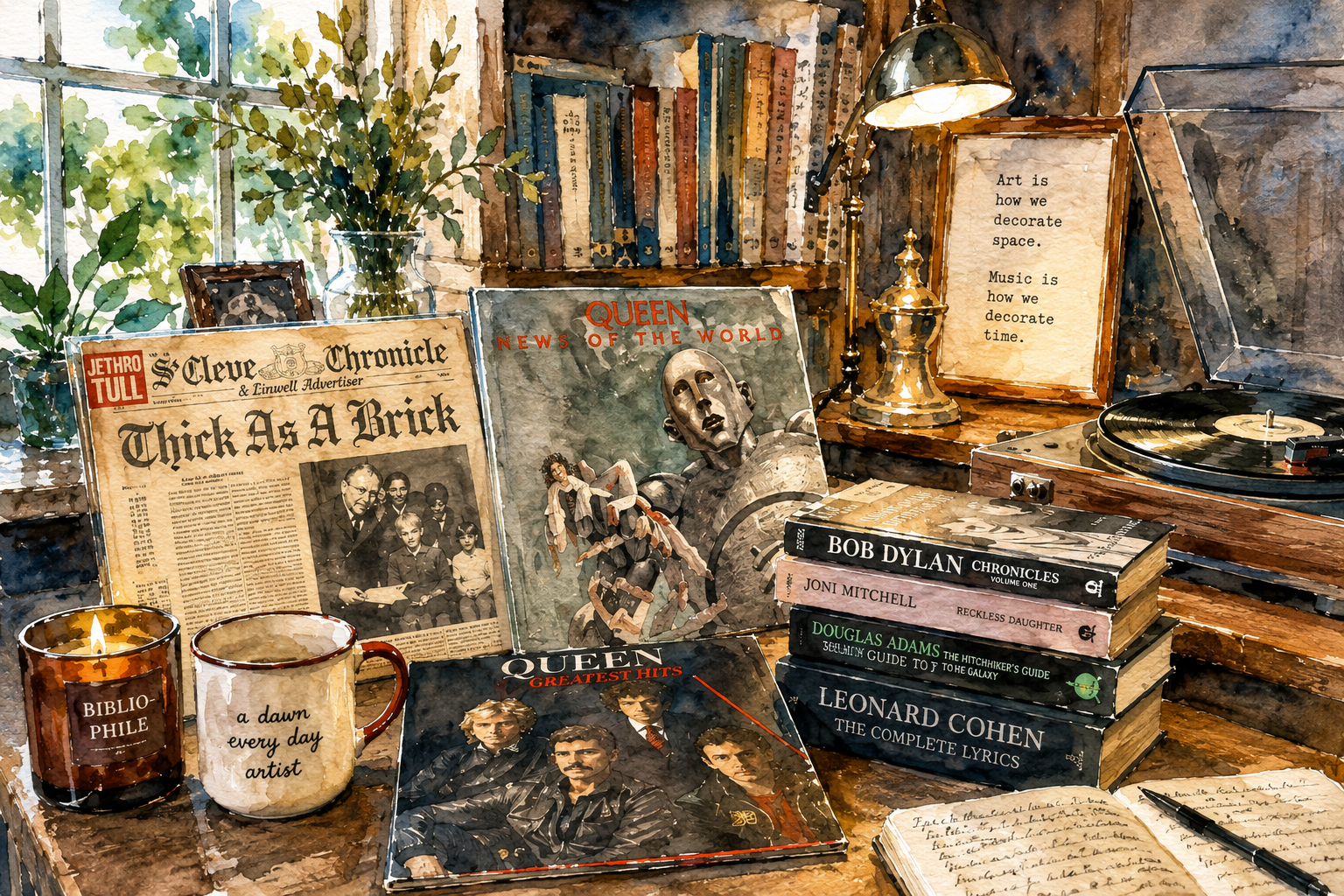
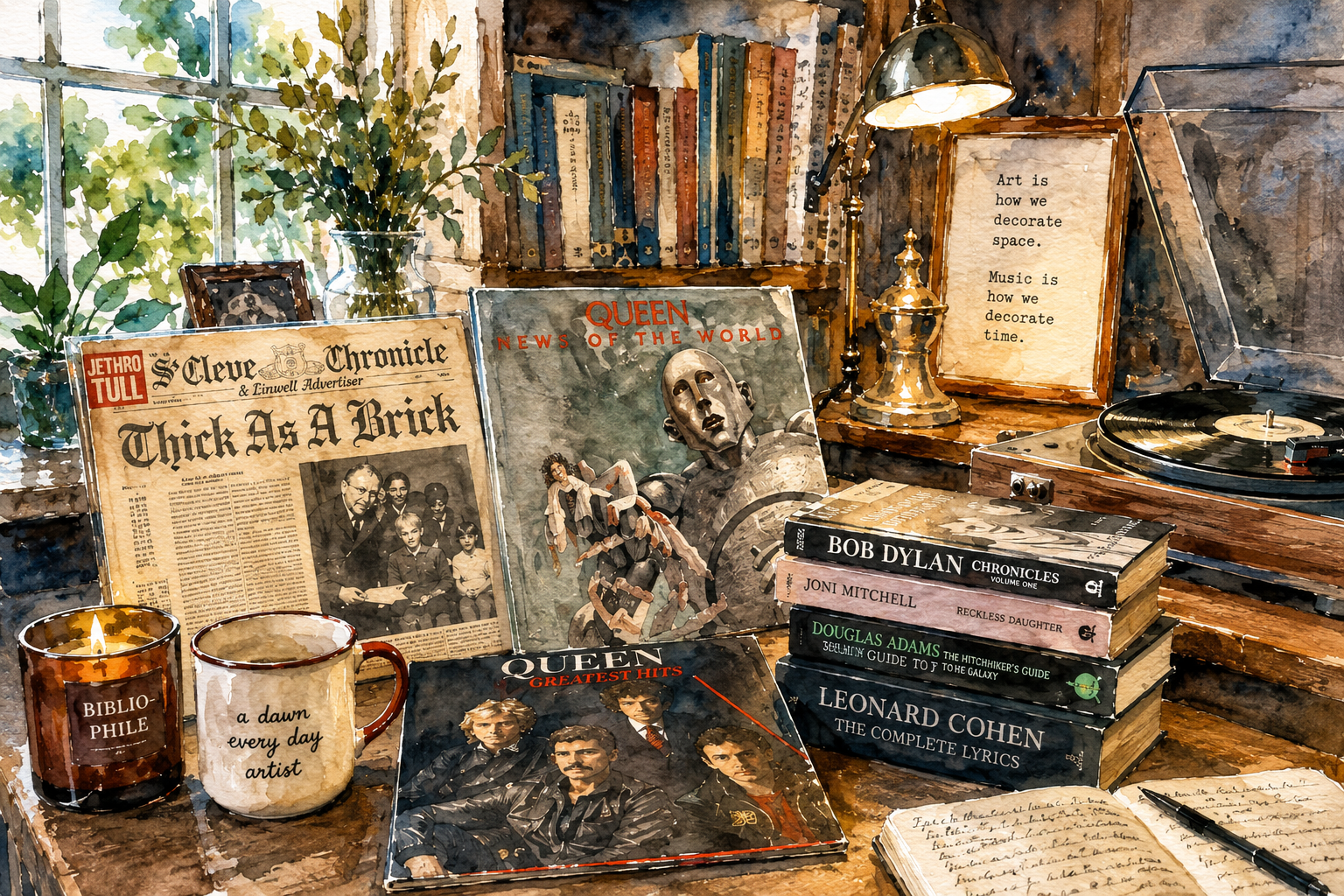
One of the first records that really drew me in was Thick as a Brick by Jethro Tull.
I didn’t know Tull, although someone I knew was a big fan. Coincidentally, I also remembered seeing the name on cassette tapes in my husband’s kitchen when we first dated.
Instead of simply listening to the album, I researched it.
It was a parody. A joke. A jab at critics who had labeled the band’s previous album a “concept album.”
Ian Anderson was frustrated by that label.
His response seems to have been: Oh, you want a concept album?
Fine.
Here’s an absurdly elaborate fake newspaper wrapped around one impossibly long song.
They created the most outlandish, over-the-top concept album they could imagine, complete with a twelve-page newspaper cover. It was supposed to be a joke. The sandcastle man? Retired. The nonrabit? Found. A cross word puzzle. And advertisement. Sure.
Well, the joke backfired.
In trying to make the joke bigger, they created something great—something beloved and critically acclaimed. They were too good to fail? I don’t know. But it was a delicious and appealing story.
Finding the Monty Python connection sealed it.
Do you have any shrubbery?
I’m not dead yet.
The dead parrot sketch.
Yes. These were my people.
On a whim, I searched to see what an original pressing would cost.
And I stumbled upon one.
Near-mint condition. The elaborate newspaper foldout still intact.
It was too easy.
The price wasn’t outrageous. I expected some wear. I assumed the original sleeve hadn’t survived. I thought that if the record wasn’t scratched or warped, it was definitely worth grabbing.
I bought it.
It arrived in the mail, and it was more than I had hoped for.
Holding it felt different than streaming the music.
It felt like holding an idea.
Someone had imagined this wonderfully eccentric package and sent it into the world. The album wasn’t just music. It was storytelling, design, humor, and craftsmanship all working together.
Then came Queen.
First, A Night at the Opera—a near-mint original pressing and another piece of history.
Bohemian Rhapsody.
A song that refused to behave like an ordinary rock song. Opera, theater, camp, virtuosity, and complete commitment to an idea that shouldn’t have worked—but did.
Then News of the World.
We Will Rock You.
We Are the Champions.
Songs that somehow escaped their own era and became part of ours.
And then there was the artwork.
The enormous robot.
The theatricality.
The willingness to be strange, dramatic, and unapologetically imaginative.
Queen never seemed interested in staying in one lane. Rock, opera, music hall, theater, science fiction—they weren’t interested in being ordinary.
It wasn’t just an album.
It was evidence that creativity doesn’t always arrive quietly.
Sometimes it arrives wearing a cape.
I’m still learning.
Bob Dylan recently found his way onto my shelves, and I suspect many more artists will follow. Kate Bush I love. Will I collect her’s? Or Siouxsie and the Banshees? Blondie? Patti Smith? The Pretenders? Hole?
Some I’ll choose because history says they mattered.
Others because they simply speak to me.
Perhaps that’s the real lesson.
Curating isn’t about proving good taste. For everyone. I guess we have to qualify that. :)
For me, it’s about paying attention. And deepening that attention.
It’s about asking why something has endured.
Why it still makes people stop.
Why it makes ME stop.
Why it still deserves a place in the conversation.
It’s also about trusting my own eye, my own ear, and my own judgment.
And maybe, years from now, when one of my children pulls a record from the shelf or opens a well-loved book, they won’t just inherit an object.
They’ll inherit the questions that built the collection.
And, I hope, permission to ask their own.
To me, that’s worth preserving.

Talk to me: Two Pinot Noirs, Doubled the Evenings
noir vs noir
The Firesteed was the bottle I expected to love.
I poured a glass of Firesteed and a glass of Dark Horse beside a slow-baked lasagna layered with vegetables, tomatoes, herbs, and cheese. The Firesteed had the awards. It cost a little more. I assumed it would be the winner.
Instead, I found myself disappointed.
Not in the wine.
In the pairing.
The Firesteed's lighter, berry-forward character simply wasn't what the lasagna wanted to be paired with.
The Dark Horse, with its little more weight and structure, stood comfortably beside the meal. It didn't overpower the food, and the food didn't overpower it. They seemed to understand one another.
The glass of the Firesteed weighted for dessert.
This time I enjoyed it with a warm cherry turnover and vanilla ice cream.
Suddenly everything clicked.
The bright berries that felt almost too delicate beside lasagna echoed the cherries in the dessert. Its lighter body and softer grip let the sweetness remain the star. It wasn't trying to compete. It was completing.
The wine hadn't changed.
Only its companion had.
Both Pinot Noirs, but both meant for different accompaniment.
It’s not about which one is better.
It’s about which one brings out the best of its companion.

More Than Pairings—A Salon Life
pairings and rituals
There are recipes for food, and then there are recipes for living.
Lately I've been thinking about pairings, a salon—not simply what tastes good together, but what quietly enriches each other in an ordinary day.
Writing in bed while listening to Mr. White by Khruangbin. The guitar riffs demand my attention, interrupting one thought just long enough for another to surface, while the soft sizzle of the drums keeps everything moving forward.
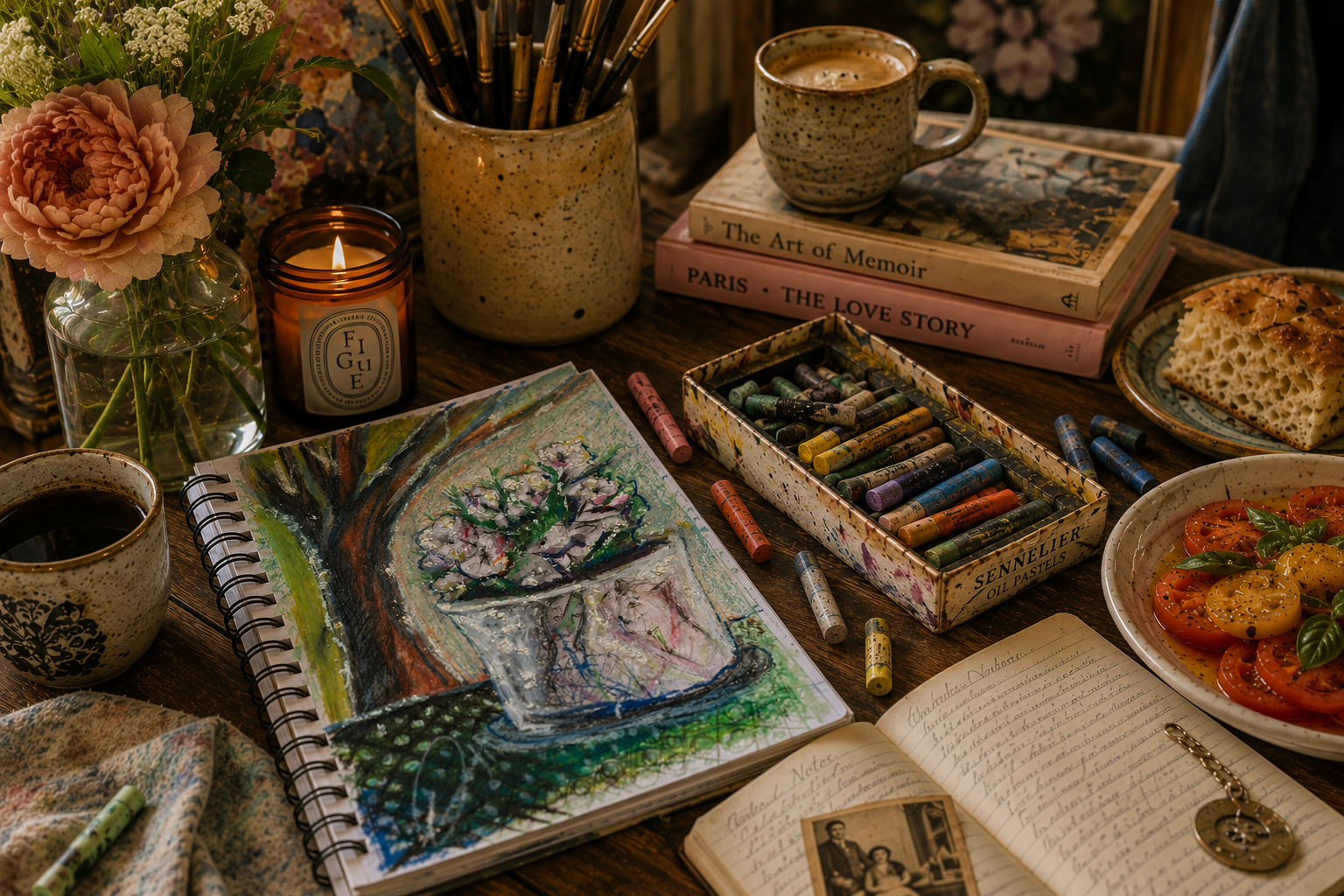
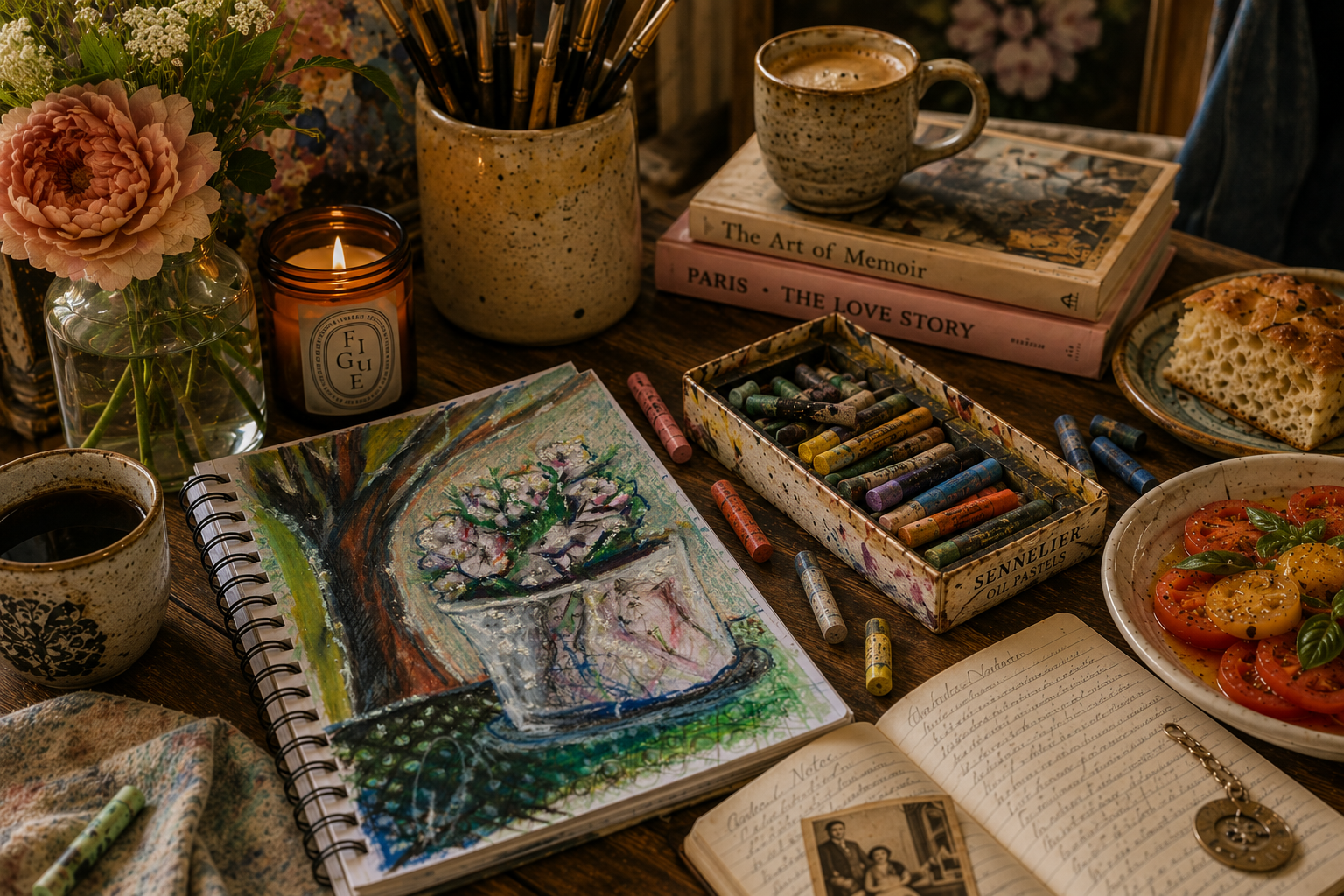
A warm slice of home-baked focaccia paired with a rich espresso.
Garden tomatoes with basil, olive oil, and a little flaky salt.
A mixed-media painting that asks for one more layer while a favorite playlist wanders through the room.
A memoir beside a sketchbook.
A vintage bracelet paired with a linen dress. An old artifact beside something beautifully modern.
The company of tree frogs. Rupert in his little garden home. Lenny, forever convinced the shower belongs to him.
These combinations don't happen by accident. They are collected over time, like favorite recipes tucked into a worn notebook.
Perhaps that's what a salon has always been—not a place of perfection, but a place where ideas gather.
A painting beside a poem.
A recipe beside a conversation.
A well-loved chair beside a window.
Friends who make you laugh.
Music that changes the light in a room.
I'm currently reading The Art of Memoir alongside Paris: The Love Story. One explores how we tell the truth about our lives. The other reminds me that places become meaningful because of the people we carry through them. They make surprisingly good companions. They are books about invention and reinvention, about reflection, romance, and creating new storylines from old ones.
While I read, there are notes accumulating in my vintage notebook. Outfit ideas. Color palettes. Garden observations. Fragments of essays. Things customers say in the shop. A phrase from a song. A recipe worth making again.
Nothing seems related until, suddenly, it is.
I've realized I don't want my days to feel optimized.
I want them to feel curated.
There is a difference.
Optimization asks how much can fit into a day.
Curation asks what belongs together.
Curation is holding an old vinyl record up to the light and inspecting the ridges.
So I pair books with breakfast.
Boots with dresses.
Music with painting.
Gardening with quiet.
Vintage with modern.
Conversation with curiosity.
And long summer afternoons with the permission to do just enough.
Maybe that's why I've been smiling every time I hear Rose Pink Cadillac. It reminds me that joy doesn't always arrive through someone else's grand gesture. Sometimes it arrives quietly, in the affection we cultivate for our own lives.
These are my salad days.
This is my own Rose Pink Cadillac.
Not because they belong to youth, and not because they belong to someone else's evaluation, but because they belong to my own cultivation.
A season of tomatoes ripening on the vine.
A table set with simple food.
Paint drying in the studio.
The garden humming.
The espresso still warm.
The notebook open.
That is why I like indie.
That is why I like those who walk just outside the categories, with one foot in the past and their head in the clouds.
Our jackets fit perfectly, but our shoes don't.
It's in those slightly unbalanced lines that something interesting happens.
Wabi-sabi.
Eclectic.
Curiosity-shop people.
Happy to rummage through civilization and create something...
...thoughtfully.
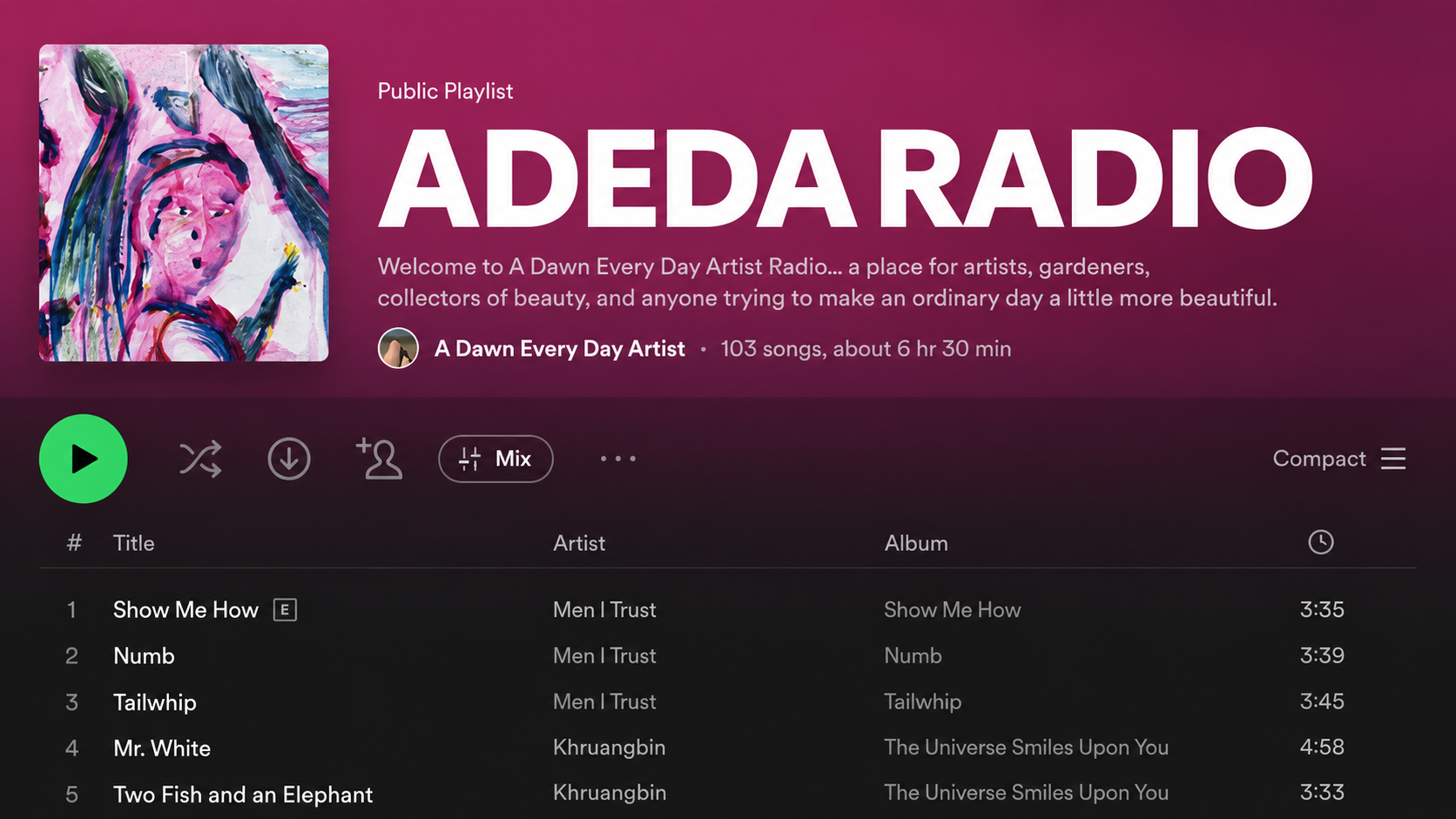
ADEDA Radio, the radio station that’s not
ADEDA RADIO
There was a time when the radio introduced us to the world. Hello Radio. Now we stream.
Back then, you didn't choose every song. Someone else did.
Some stranger, somewhere in a booth, believed that this song belonged beside that one. They trusted you to come along for the ride.
Streaming has given us infinite choice.
And it’s reinvigorated my love of the mix tape.
So Spotify is now a place I create Radio Stations that aren’t.
I like the idea of building a space and inviting people into it.
I called this one ADEDA Radio.
The rules are simple.
If a song belongs in the soundtrack of an ordinary, beautiful life, it has a chance of finding its way here.
That means you might hear Khruangbin while watering tomatoes.
Mac DeMarco while steaming vintage dresses.
Lana Del Rey just after sunset.
Men I Trust with your first cup of coffee.
Bon Iver when the weather turns.
I don't believe playlists need to be perfect.
I think they need to be inhabited.
Like old houses, gardens, or collections of milk glass, they become interesting because someone actually lived there.
The songs begin talking to each other.
The indie dream pop reminds the soul records where they came from.
The vintage rock nods toward something released three months ago.
A French disco groove somehow understands an Appalachian folk song.
Eventually it stops feeling like a playlist.
It starts feeling like a place.
That is what I wanted.
A room where artists can paint.
Gardeners can weed.
Collectors can dust a shelf.
Someone can write a difficult paragraph.
Someone else can simply sit with coffee while the morning light moves across the floor.
There is no algorithm trying to hold your attention here.
Only a quiet hope that one good song might make an ordinary Tuesday feel a little more like your own life.
And if, while you're listening, a goblin kitten decides the warmest place in the house is your lap for a nap...
...perhaps that's the highest review any radio station could hope to receive.
Featured on ADEDA Radio
This month's listening drifts between dreamy indie, psychedelic pop, soul, and quiet folk—music for painting, writing, tending gardens, wandering vintage shops, or simply letting an ordinary afternoon unfold. I don’t know if I’ll do this every month, but it is enjoyable to com
Dream Pop & Indie
Men I Trust — Show Me How
Tame Impala — Eventually
Mac DeMarco — Heart to Heart
Bon Iver — Skinny Love
Beach House — Space Song
Khruangbin — Friday Morning
Unknown Mortal Orchestra — Hunnybee
Mild High Club — Homage
Parcels — Overnight
Jungle — Keep Moving
Neil Frances — Took a While
Folk & Quiet Mornings
Billie Marten — La Lune
Lana Del Rey — Mariners Apartment Complex, Ride, West Coast
Soul
Otis Redding — These Arms of Mine, I've Been Loving You Too Long
After Dark
Billie Eilish — BLUE
From the Curator
I don't build playlists around genres. I build them around moments.
Music for opening the windows.
Music for watering tomatoes.
Music for steaming vintage dresses before the shop opens.
Music for painting while a kitten decides your lap belongs to him.
Music for crossing the bridge with the windows down.
Music for remembering that ordinary days are worth paying attention to.
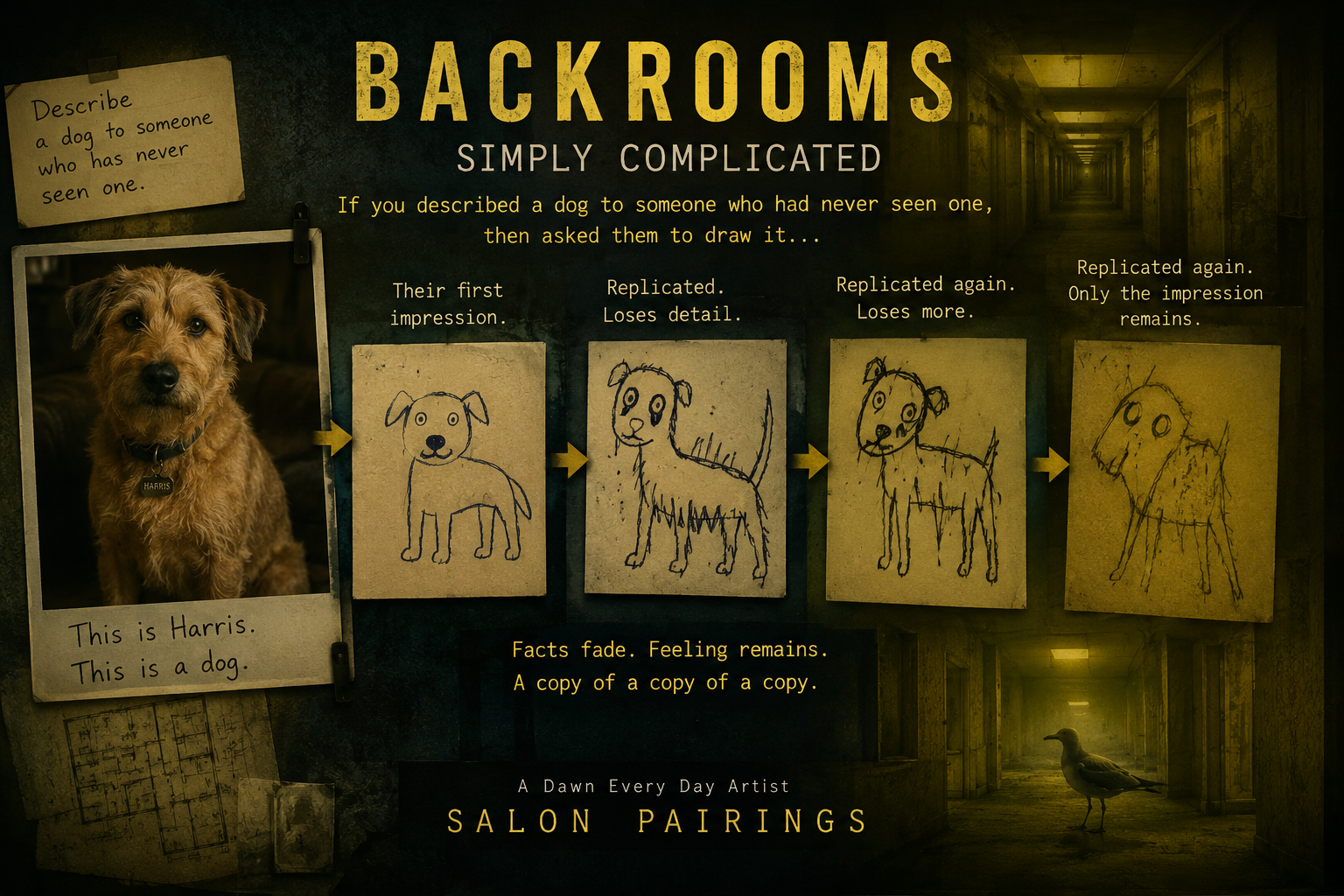
Backrooms: Simple. It’s Complicated.
Backrooms Movie is simply complicated
There are movies that explain everything.
There are movies that explain nothing.
And then there are movies like Backrooms, which explain just enough to make you wonder if you understood any of it at all.
My son and I recently watched it together. We both agreed on the same review:
"Really good weird."
He applauded at the end and made me sit through the credits.
From him, that is a very high compliment.
At first glance, Backrooms appears to be a familiar horror story. Strange creatures lurk in endless corridors. Reality fractures. People become trapped in a place that should not exist. Probably a government experiment gone wrong. A Cold War accident.
But the longer I thought about it, the less interested I became in the monsters.
The rooms are copies.
The furniture is copied.
The stores are copied.
Dull. Lifeless. The worst kind of box-store furniture copies. D.O.A.
The hallways stretch on forever, reproducing themselves with dull persistence. Only the occasional M.C. Escher distortion saves the endless architecture from complete monotony.
Yet these things remain mostly lifeless.
A chair remains a chair.
A shelf remains a shelf.
A room remains a room.
The energetic distortions seem to happen when the Backrooms encounters people.
Not their bodies.
Their emotional impression.
Consider Captain Carl, or just Carl.
The phenomenon does not create an accurate version of Carl. Instead it appears to amplify something darker. Anger. Frustration. Resentment. Hunger.
The result is not a replica but a nightmare interpretation.
The same thing happens to the psychologist.
Her story is rooted in memories of her mother, isolation, mental illness, and a deteriorating apartment that was destined to disappear. As the film progresses, her memories seem to fragment and repeat. The details blur. The emotional weight remains.
By the end, what survives is not a factual recreation of her life.
It is an impression.
A posture.
A feeling.
A tired woman sitting in a kitchen.
Not reality.
Memory.
The more I considered it, the more I wondered if the Backrooms does not replicate objects at all.
Perhaps it replicates significance.
The phenomenon appears indifferent to furniture but fascinated by emotional energy.
Fear.
Grief.
Anger.
Despair.
The stronger the feeling, the more material it has to work with.
The resulting copies are inaccurate because memories themselves are inaccurate. We do not store our lives as perfect recordings. We store impressions. We remember emotions long after details disappear.
We remember what something felt like more than what it actually was like.
A childhood home can remain vivid while the actual floor plan becomes impossible to recall.
An argument can be forgotten while the hurt remains.
A person can vanish while the feeling they left behind survives for decades.
A radioactive shadow casting of emotion.
The Backrooms seems to operate according to similar logic.
Every copy drifts further from the original.
Every repetition loses information.
Every recreation becomes stranger.
Like a photocopy of a photocopy of a photocopy.
Until eventually only the emotional residue remains.
One small moment in the film captures this beautifully.
A seagull accidentally flies through an opening into the Backrooms.
It is not chosen.
It is not special.
It simply takes a wrong turn.
The bird crashes and dies much like birds sometimes fly into windows in our own world.
The scene is brief but unsettling.
It suggests the phenomenon is not targeting anyone.
It simply exists.
Reality has developed a leak.
Sometimes people fall through.
Sometimes birds do.
The universe is not angry.
The universe is not kind.
It is simply complicated.
And perhaps that is what lingers after the credits roll.
The monsters are frightening.
The hallways are strange.
But the deeper horror may be the possibility that memory itself is unstable.
That our strongest emotions survive while the facts dissolve around them.
That what remains of us is not an accurate record.
But a psychic impression.
An energetic feeling.
A story retold too many times.
Perhaps that is the true horror of Backrooms.
Not that we are forgotten.
But that what survives of us may not be the facts.
Only the feeling.
A psychic impression.
A radioactive shadow cast by memory.
A copy of a copy of a copy.
Simply complicated.
That’s what I think. Now you? What did you think? Simply terrible or something more than you gave it credit for?
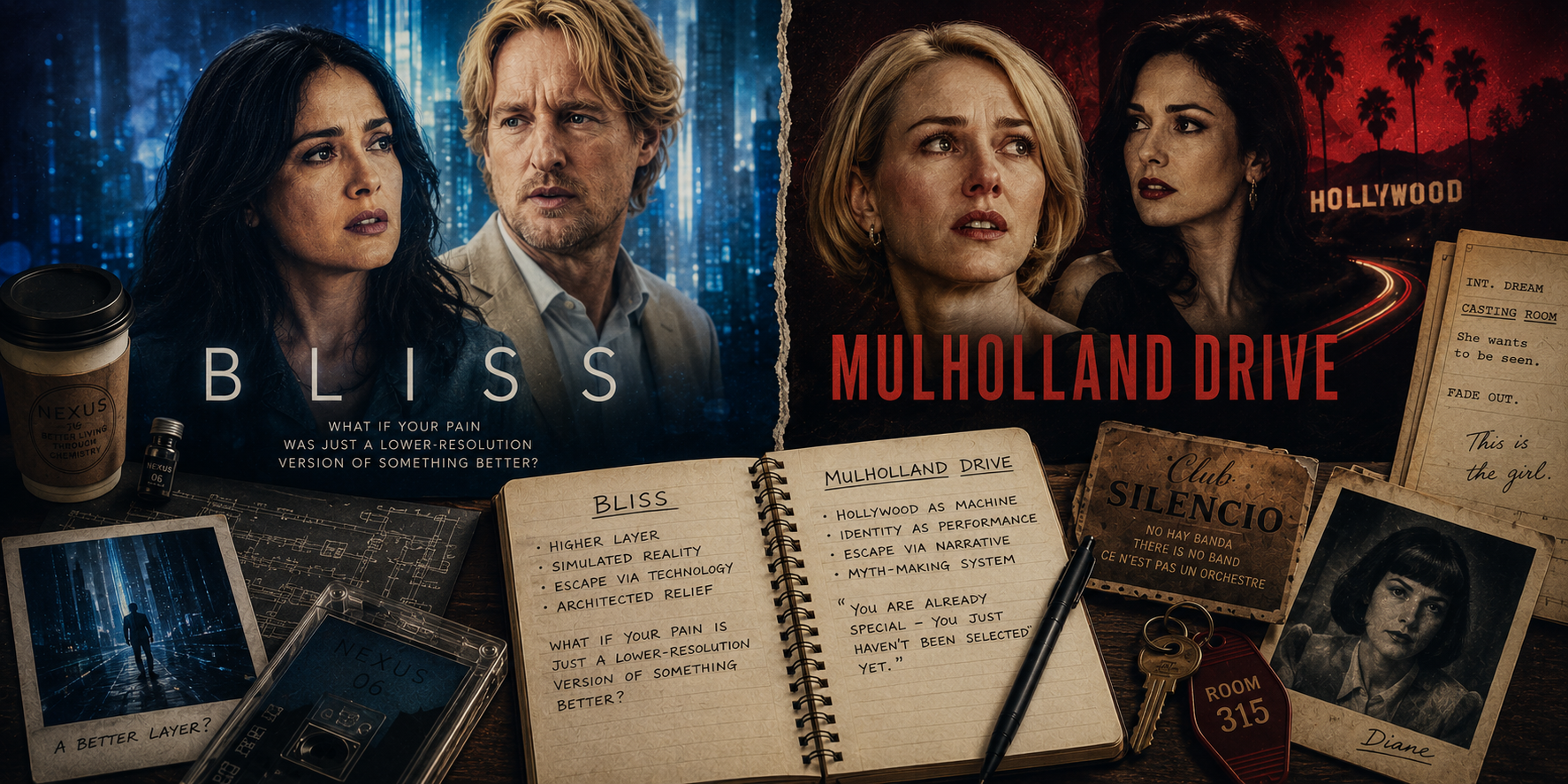
Bliss vs. Mulholland Drive and the Desire for Beautiful Lies
Reality Vs Narratives
There is a kind of modern story that doesn’t ask us to choose between truth and illusion.
It asks something stranger:
How much illusion can a human mind hold before reality pushes back?
Two films—Mike Cahill’s Bliss and David Lynch’s Mulholland Drive—sit on opposite ends of that question, but they orbit the same emotional truth: we do not live inside reality first. We live inside interpretation.
Writers, in particular, think in narrative and character. These films indulge that instinct, but also expose its limits.
Interpretation is often kinder—and more shallow—than truth.
1. The Promise of a Better Layer
In Bliss, reality is messy, fractured, and chemically destabilized. The solution appears simple: step into a higher, more coherent layer of existence. A simulated world. A cleaner narrative. A place where suffering has been reorganized into meaning.
It is not just escapism—it is escapism with architecture.
A system that suggests:
What if your pain is just a lower-resolution version of something better?
And for a moment, it works.
Because the brain recognizes relief, even when it is manufactured.
In Mulholland Drive, the promise is older and more culturally embedded: Hollywood.
Not just a place, but a machine for identity production.
Here, the promise is not escape from reality—it is escape from insignificance.
You are not just a person.
You are:
the chosen one
the talented one
the discovered one
the one who will be seen
Hollywood is the dream that says:
You are already special—you just haven’t been selected yet.
2. The Construct as Comfort
Both films understand something uncomfortable:
The mind prefers a structured illusion over an unstructured truth.
In Bliss, the structure is technological.
In Mulholland Drive, it is psychological and industrial.
One is built from machines.
The other is built from myth.
But both function the same way:
they organize chaos
they assign meaning to pain
they convert uncertainty into narrative
they make the unbearable feel navigable
This is why both films feel emotionally coherent even when their logic breaks down.
They are not really about plot.
They are about the human need to not fall apart inside ambiguity.
3. When the Construct Breaks
The crucial difference is how each film handles collapse.
In Bliss, the fracture is technological: the system cannot hold contradictory realities at once. The illusion becomes unstable under competing layers of experience.
In Mulholland Drive, the fracture is psychological: desire, guilt, jealousy, and identity cannot coexist without distortion.
But the result is similar:
The constructed world fails to protect the mind from what it already knows.
That failure is not abstract.
It is deeply personal.
Because what breaks is not “reality.”
It is the story that made reality survivable.
When the narrative fails, we are left with something less organized—but more real than expected.
4. Diane and the Cost of Narrative
If Mulholland Drive has a center, it is narration.
Diane does not simply experience loss.
She constructs an alternate continuity in which:
she is more powerful
she is more loved
she is more chosen
she is less responsible
The dream is not random.
It is authored.
Which is why it collapses.
Because authored worlds cannot permanently suppress what is already known.
The truth does not arrive dramatically.
It returns structurally.
5. The Shared Thesis
Placed side by side, Bliss and Mulholland Drive stop being genre experiments and become something more aligned:
Two studies of consciousness building shelter from reality—and the cost of that shelter collapsing.
One asks:
What if we can upgrade reality?
The other asks:
What if we can rewrite it?
But both arrive at the same unsettling recognition:
The mind does not experience truth directly.
It experiences versions of truth it can tolerate.
And when those versions fail, collapse is not intellectual.
It is existential.
6. The Afterimage
What remains after both films is not clarity.
It is residue.
A feeling that:
reality is layered
identity is negotiable
desire edits perception
stories are structural, not optional
But also:
no story holds forever
Which may be the most human point they share.
Not that illusion is false.
But that it is temporary.
And what returns when it fails is not revelation.
It is experience, unbuffered.
In that sense, both films are not about escaping reality.
They are about the moment escape stops working.
And what is left standing when it doesn’t.
We are not lost in stories.
We are lost in the act of making them.
And sometimes—just sometimes—we catch the seams.
We are lost in our own brain boxes wandering around Mulholland Drive.
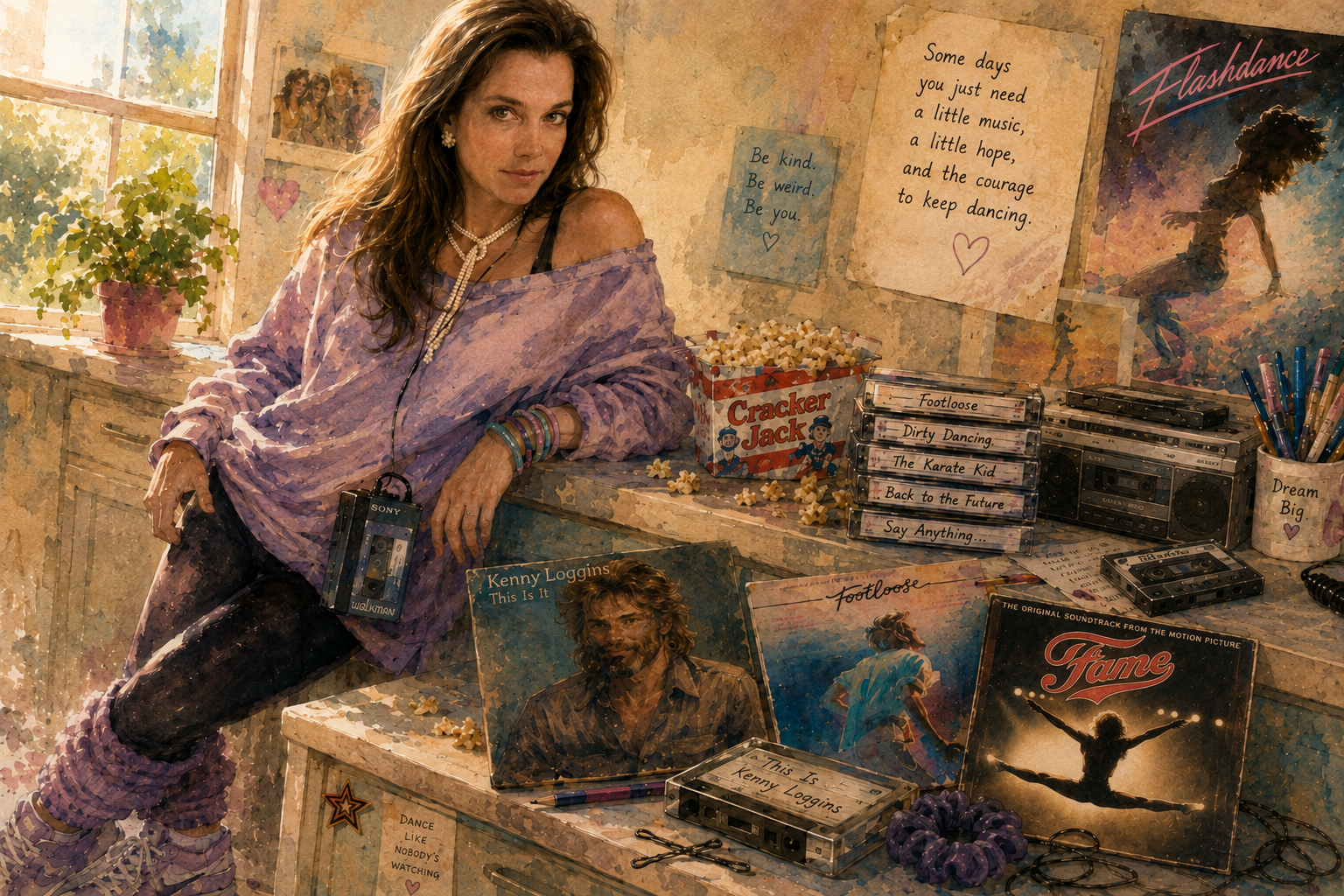
In Defense of Cringe AKA The Secret Pleasure of Sincere Things
In Defense of Cringe aka the 80s
It started with a Kenny Loggins album cover.
Well, actually it didn't.
It started with a feeling.
Sincerity.
Care.
Encouragement.
This I had felt when I was nine.
My world was smaller.
Brighter.
Bluer.
Black-and-blue parts existed, but they hadn't taken hold of me yet.
Then one afternoon a song appeared in my head out of nowhere.
"This Is It."
I hadn't heard it in years.
I don't know why it arrived.
Maybe some loose connection between old movies and old soundtracks.
Maybe memory was digging around in the attic.
Maybe part of me missed something I hadn't realized I was missing.
So I played it.
And then I found myself staring at a Kenny Loggins album cover.
Bright colors. Big hair. Unapologetic optimism. The sort of thing that modern culture often treats with a mixture of amusement and secondhand embarrassment.
Cringe.
The word appears quickly these days.
Someone is too enthusiastic.
Too earnest.
Too sincere.
They care too much.
They believe in something openly.
They are trying.
And trying, perhaps more than anything else, has become unfashionable. Caring is uncool. How stupid is that for society? How foolish?
It is unfortunate because many of the things we secretly love are built entirely from sincerity.
Lately I've found myself gravitating toward films and music from the 1980s.
Not necessarily because they are masterpieces. Far from it.
Not because I want to relive the decade. Again, FAR from it.
But because there was an “unashamedness” of their own hearts.
Life is messy.
People fall in love.
Friendships matter.
Dancing matters.
The underdog gets a chance.
The underdog wins! Over and over again.
The soundtrack believes every emotion deserves an anthem.
Nobody seems particularly concerned with appearing cool.
The movies are trying very hard.
And somehow that effort becomes part of their charm.
Watch Footloose.
Watch Dirty Dancing.
Watch The Karate Kid.
Watch Back to the Future.
Watch Say Anything...
There is a certain emotional transparency running through all of them.
They are not embarrassed by hope.
The heroes care.
The dreamers care.
The weird kids care.
The audience is invited to care too.
Perhaps that is what feels refreshing.
Modern culture often rewards distance.
We become observers of our own lives.
Commentators.
Curators.
We learn to place everything inside quotation marks.
Even our passions.
Especially our passions.
"I know this is silly."
"I know this is cheesy."
"I know this isn't cool."
A disclaimer before enthusiasm.
A protective shield against judgment.
Yet some of the most beloved things in human life arrive completely unprotected.
A mixtape.
A love letter.
A handmade gift.
A teenager learning guitar.
A grandmother keeping a scrapbook.
A gardener talking to her roses.
A friend sending you a song because it reminded them of you.
These things survive because they are sincere.
Not despite it.
Because of it.
Modern life seems to punish us for sincerity. And for caring.
Which is why I find myself increasingly suspicious of cringe as a cultural category.
Often what we call cringe is simply visible enthusiasm.
Someone loving something without enough protective irony.
Someone risking embarrassment in exchange for genuine expression.
Someone choosing participation over performance.
Maybe that is why Lloyd Dobler standing beneath a window holding a boombox remains such a strangely enduring image.
It is ridiculous.
It is earnest.
It is vulnerable.
It is trying.
The 80s? People fell in love with Mannequin (an Egyptian cursed mannequin) and Number 5 (a fragged military robot) and E.T. (he was creepy looking to say the least).
Xanadu….. uh, alien botanist?
And perhaps we recognize that what makes it memorable is not the grand gesture itself but the willingness to risk rejection.
The willingness to care publicly.
To love publicly.
To hope publicly.
To be a nerd.
Nerds. Nerds. Nerds. Nerds. chants in the background. Goonies! Hell ya!
Maybe what many of us are longing for is not a return to the 1980s.
Maybe we are longing for permission.
Permission to enjoy things wholeheartedly.
Permission to dance badly.
Permission to become obsessed with birds or books or herbs or old records.
Permission to create art that never becomes famous.
Permission to believe that friendship matters.
Permission to love things before we know whether they will make us look impressive.
The permission to return to innocence and sincerity.
Give me stories where friendship matters.
Give me music that believes in itself.
Give me movies where the kids get their happy ending.
Give me dancing.
Give me hope.
Give me the glowing orb.
Give me a soundtrack that isn't embarrassed to care.
Because perhaps the opposite of cringe is not coolness.
Perhaps the opposite of cringe is courage.
And perhaps the things that make us feel most alive have always required a little of it.
What would you love openly if you stopped worrying whether someone else thought it was cool?
What would you love without the world's approval?
I'd like to know.
Who were you before middle school?
Before high school?
Before college and student loans and twenty-four-hour news cycles?
Who were you before personal branding?
Before algorithms?
Before you started performing for Facebook?
Who were you before the audience arrived?
I’ll wait. I’ll be over here snacking on Cracker Jacks listening to my Walkman with the Flashdance soundtrack, wearing legwarmers with jellies, my hair in a side pony. Just hanging out. We did a lot of that back then.
Wrestling with the Spider Man in the Dark
Wrestling with the new Spider Noir In the Dark
I love noir. That is established.
But I didn’t realize there were different species of noir, see?
I knew urban decay noir.
Rainwater in potholes.
Cigarette burns.
Exhaustion.
The rotten apple version of the city.
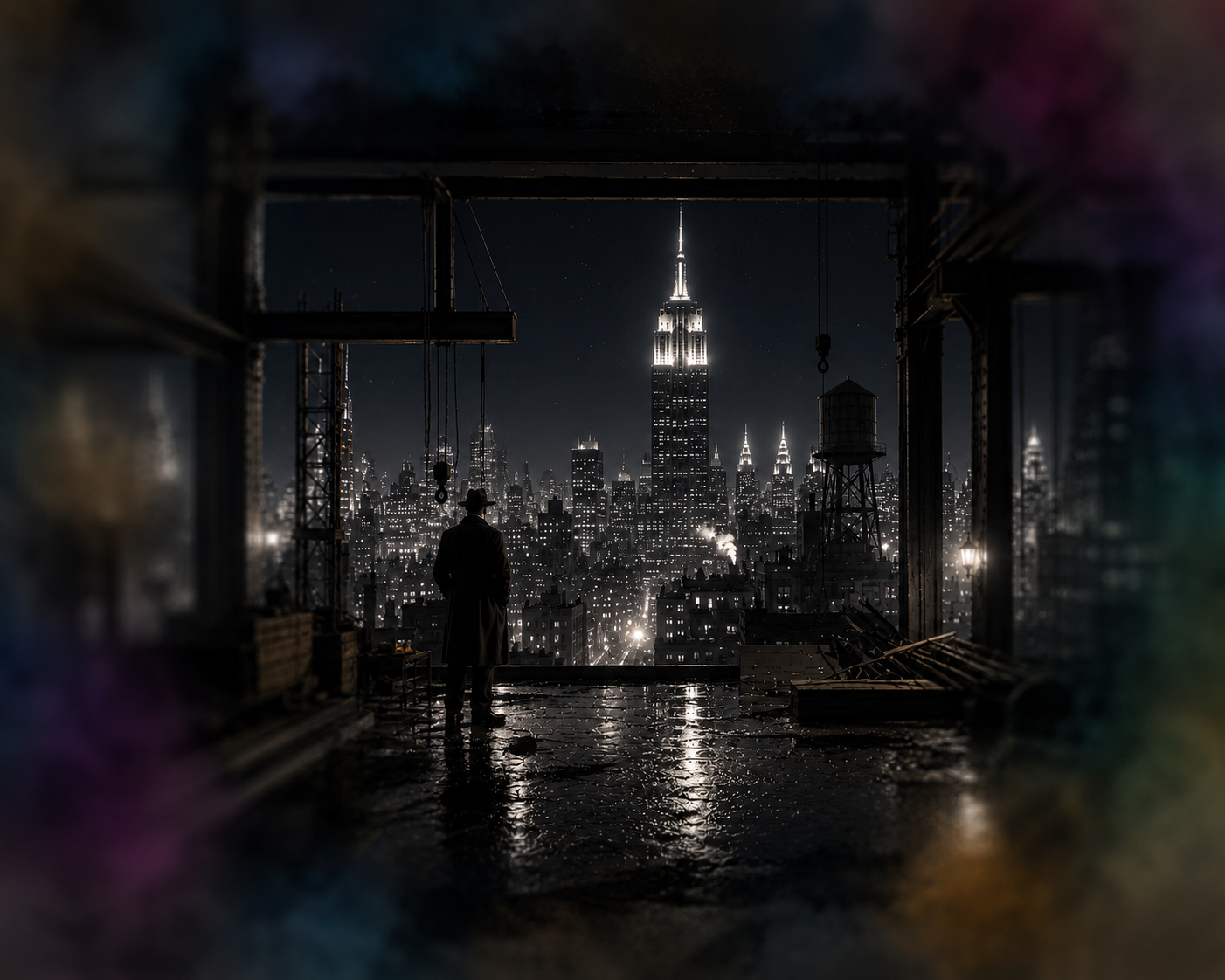
So when Spider-Noir opened in silver-toned Art Deco modernism, I resisted it a little.
And Nicolas Cage as Ben—
mmm.
At first he felt too much like Nicolas Cage.
Not worn enough.
Not absorbed enough into the role.
Was Cage tired?
Or was Ben tired?
It takes time sometimes.
Then something shifted.
The angles changed.
The upshots of his face.
The silhouettes.
The framing.
Ben started becoming more of the guy.
And the city revealed itself too.
Not decayed.
Not morally exhausted.
Young still.
Lovely in places.
Clean lines.
Cut glass.
Sconces glowing softly in dark rooms.
This wasn’t the rotten apple.
This was the promise of the big apple.
And somewhere in the middle of the evening, you realize it has happened:
You’ve stopped fighting the vision.
This is Art Deco modernist noir.
A tribute made with intention by people who genuinely respect the genre.
Will it become wonderful?
I don’t know yet.
But I can give it a chance.
Poor Ben.
The crackling of intuition.
Spider-sense.
The low electrical hum beneath the city.
The signal.
Something bad is afoot.
And then suddenly—
one of those impossible graphic novel shots arrives on screen, all shadow and angle and suspended tension—
and you remember why noir survives every generation that rediscovers it.
Will it be loved?
We’ll see, doll.
We’ll see.
Who loves you, baby?
Maybe no one.
We’ll see.
Artificial Flowers and Other Human Inventions
Natural Flowers Wilt Take Only Memories
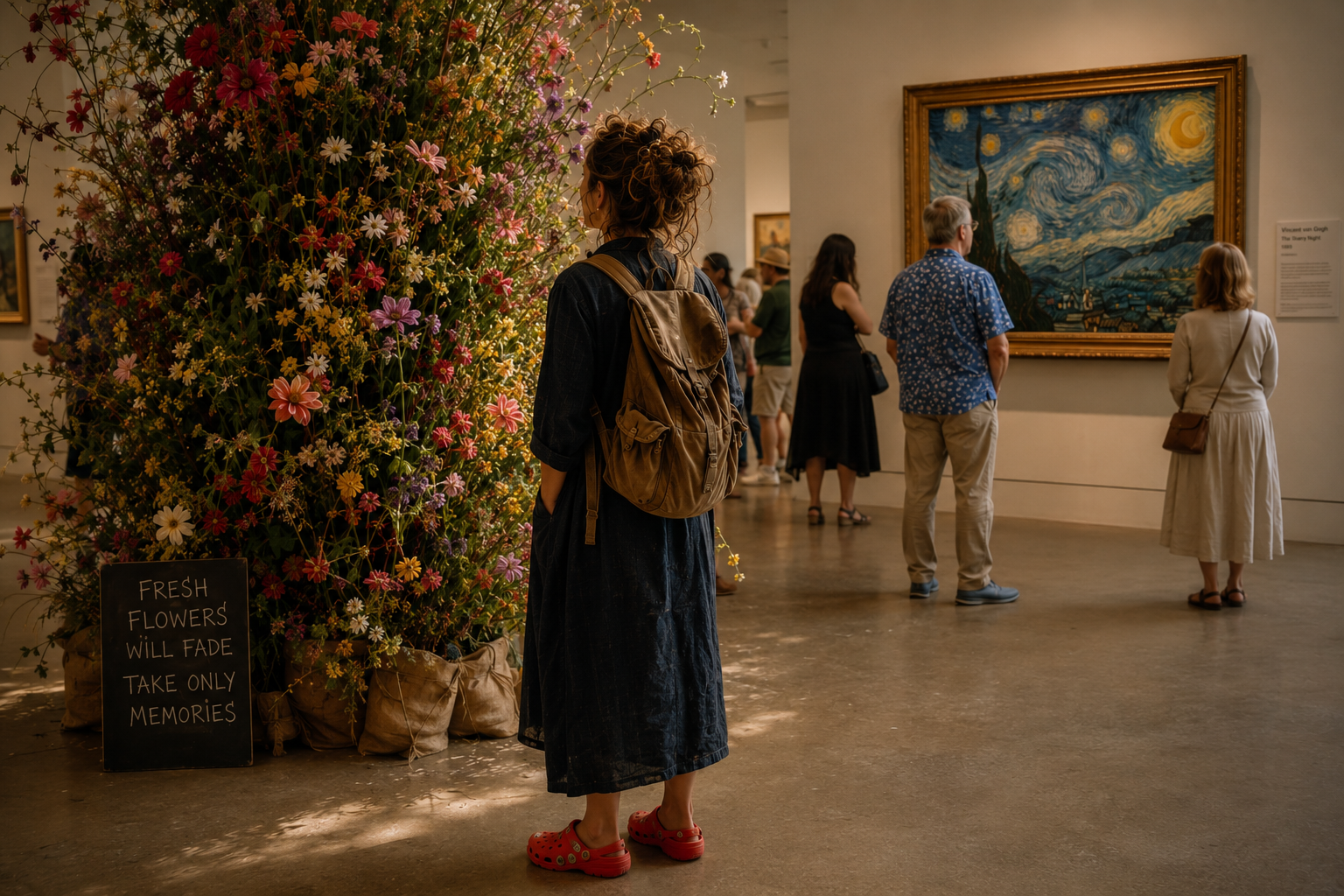
I once stood in front of immense sculptures made entirely of fresh flowers. They were stunning. They defied gravity. Some sculptors had bent natural objects into unnatural forms. Others looked like fever dreams made of petals and stems. Room to room, they changed. Not one of us was capable of taking them home. Not one of us could reproduce them exactly. Their singularity was assured by the wilting that would happen during the week.
Another time, I stood before an artwork made of wooden blocks that shifted as my shadow passed by. A pixelated image of me emerged and dissolved. I breathed. I stepped away. It altered. No one saw the same thing because no one occupied the same place at the same time.
And another time, I stood before a piece that invited flash photography. Every burst of light erased a little more of the image. By the end of the exhibit, it would be gone entirely, never to exist in that form again.
These pieces felt special.
Singular.
Impossible to replicate.
Perhaps in a world of mass production, they were a kind of reply. The freshness of the idea itself could not survive endless repetition. Their value seemed tied to impermanence. They were moments. They required interaction and time.
But something strange shifted in me while walking through those galleries.
The paintings on the wall suddenly felt less than.
Static.
Predictable.
Traditional.
They had not changed.
I had.
Somewhere along the way, I had unconsciously accepted a value equation:
Singular equals special.
Special equals valuable.
Repeatable equals familiar.
Familiar equals less valuable.
And now perhaps:
Known artist equals reproduction equals devaluation.
Ironic.
The paintings had not become smaller. A hierarchy had quietly entered the room.
Humans seem to do this often. I'm human. I can't claim I'm unaffected.
I'm infected quite frequently.
Self-awareness is the only inoculation and antidote I've found, and I have to take it regularly, like a vitamin.
We sort fruit and books and socks because sorting helps us navigate the world. But then we continue sorting long after practicality has ended.
Natural versus artificial.
Handmade versus digital.
Film versus phone cameras.
Watercolor versus digital illustration.
AI versus human.
Black and white versus color.
The starving poet versus the professor with the office.
The gallery artist versus the artist whose work appears on coffee mugs.
And somewhere along the way, categories put on crowns.
Vincent van Gogh was not universally treasured while he was alive. Later culture wrapped him in mythology. The suffering artist. The misunderstood genius. The singular voice that could never be repeated.
Now reproductions of his work cover mugs and tote bags and calendars.
Psst... by the way... he had some bad art too. Some might say muddy. He may have been not a genius, but simply human.
Something odd happens with reproductions.
We flatten the work through repetition, then mourn the loss of its specialness, forgetting that we created the hierarchy ourselves.
Even authenticity becomes slippery.
Today we hear:
"Everyone has a phone camera. That doesn't make you a photographer."
Years ago perhaps it was:
"You bought your pigments? I grind mine by hand."
Different tools.
Different centuries.
Similar anxieties.
What is really being said?
Sometimes perhaps it is:
"I devoted my life to this and I want it to matter."
I understand that.
But sometimes I wonder if another sentence hides underneath:
"I am special because I possess special knowledge, and you do not."
That feels strange and uncomfortable to me.
Not because skill differences are not real. I love admiring skill. I practice guitar badly, and I love listening to those who know what they are doing.
Not because expertise is not real. I love museums and galleries and studying the work of others.
But somewhere in society we begin mistaking artificial arrangements for nature itself.
I suspect this is why I love layers more than ladders.
I love simple bread with a complex pinot noir and a sliver of dark chocolate.
Heavenly.
But I will chow down on fries with equal pleasure.
I love my herbs in my garden, and I'm weird enough to put lavender in coffee or cocoa powder into ginger tea.
For me it's always:
Oh! Layers!
Delight rarely asks permission from hierarchy.
The world keeps trying to convince me that there are proper doors into beauty, but beauty has never behaved particularly well for me.
[I only buy real flowers.
Real flowers are often produced in unnatural ways.
I only forage flowers.
I would never take flowers from the pollinators.
I only buy artificial flowers.
Mine are made by a textile artist who lived on an island that doesn't exist anymore.]
Exhausting.
We do not have to stop appreciating what is rare or beautiful or difficult.
Maybe we simply need to remember that different is not always better, and singular is not always more worthy.
Maybe it is merely the delight it gives us or the moment of community it extends.
Art is expression.
Some things only last a week.
Some things last centuries.
Some things live on coffee mugs for a season.
Some things sit quietly in gardens.
And perhaps the point was never to climb the ladder at all.
What if art and culture were never meant to validate specialness?
What if hierarchies and standards were merely artificial flowers of our own making?
What if it was all meant to extend presence?
I tend to think the latter. I think art and culture were meant to extend presence and invite community, but somewhere along the way we became tangled in our own arrangements.
That is what I’m pondering over my macchiato. What do you think?
Inquiring minds want to know.
Top Five Relationship Songs for Actual Grown-Ups with some entirely reasonable explanations.
Top Five Relationship Songs for Actual Grown-Ups
Pop song love is often about losing. Losing ourselves. Losing the other person. Becoming consumed. Becoming consumed by. Adopting an idol. Becoming the idol. We spend three minutes and forty seconds throwing ourselves dramatically onto train tracks of devotion while strings swell in the background.
It's young. It's shiny. It burns pretty and it burns bright.
It also gives me indigestion.
Maybe that is what happens after enough years pass. You start becoming suspicious of relationships that require complete surrender. Relationships that feel like submission feel oppressive. You start noticing how often songs ask us to disappear into another person or ask another person to disappear into us. Merging. Losing our agency.
Maybe grown-up love sounds different.
Maybe it sounds less like I can't live without you and more like:
Don't run me down.
Run with me.
Run your own way.
Keep running.
We'll return home to each other.
We'll arrive home as ourselves.
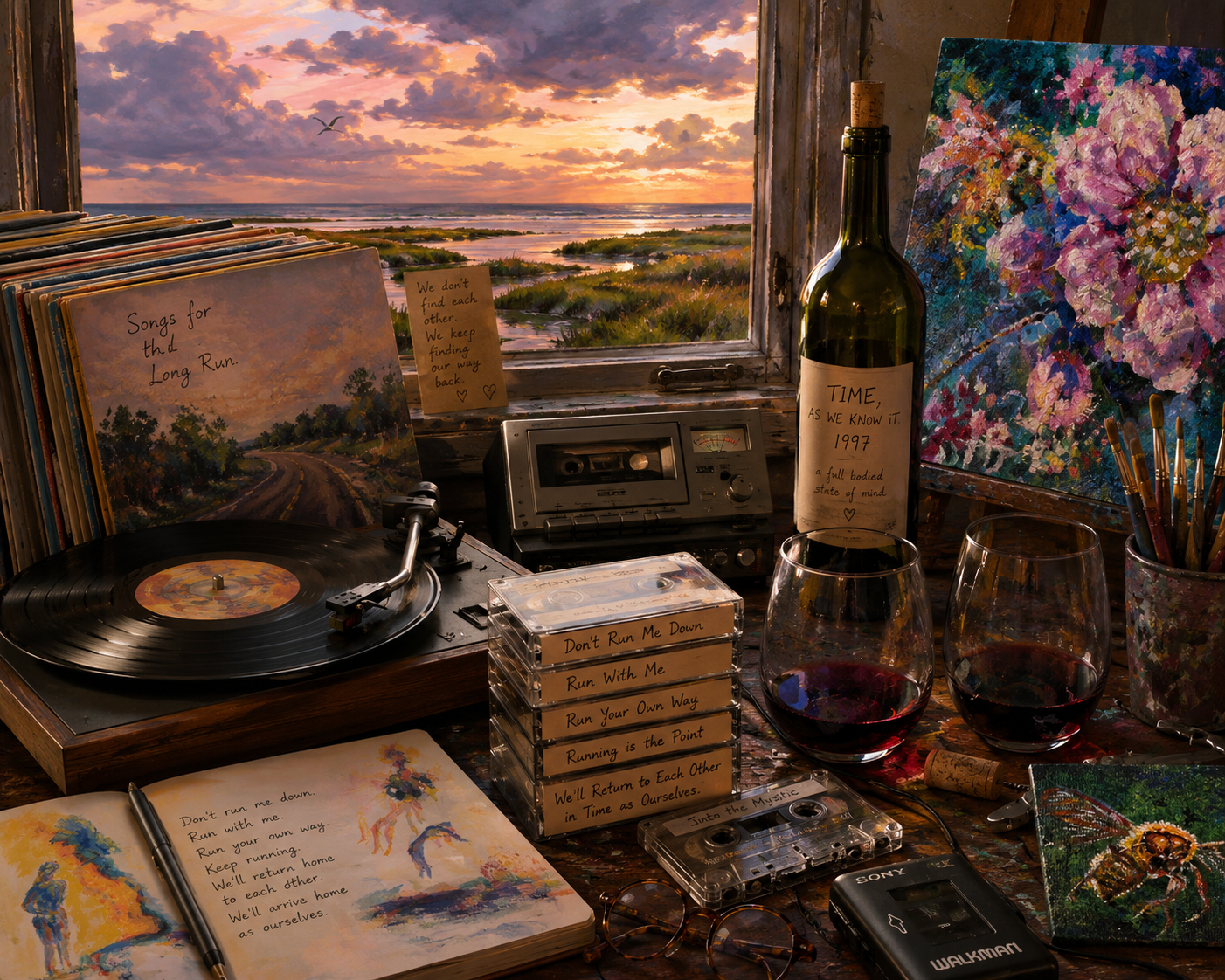
So here it is:
Top Five Relationship Songs for Actual Grown-Ups
with some entirely reasonable explanations.
Beast of Burden (Rolling Stones)
Don't run me downSend Me On My Way (Rusted Root)
Run with meGo Your Own Way (Fleetwood Mac)
Run your own wayRunning Down a Dream (Tom Petty and the Heartbreakers)
Running is the pointInto the Mystic (Van Morrison)
We'll return to each other in time as ourselves.
That’s mine. Now, what’s yours?
I had never poured two Pinot Noirs side by side before.
I had never poured two Pinot Noirs side by side before.
I had never poured two Pinot Noirs side by side before.
I had never done wine tastings. Curiosity simply got me. I love Pinot Noir — but why were some so different?
So I took two bottles from the same California coast, made from the same grape, and somehow found myself in two entirely different conversations.
Here is how it went.
It was a shallow pour.
I smelled it. Cherries. Berries. Grape. So smooth. Barely any grip at all.
By itself, it was pleasure. Easy pleasure. Done well.
Then I dared the Clos du Bois.
I poured a shallow serving into my wide goblet — maximum air. I swirled. I smelled.
Forest floor. Moss. Woods after rain.
There was an intimidating darkness in its depths.
I swept it gingerly over my tongue. Grip. Stems. Earth.
Had I chosen wrong? I had loved this wine before. What was happening?
Then I returned to the Dark Horse.
Suddenly, there were the woods. Not as mossy or dark, but sage was there now. Pepper. Dry herbs warming in the glass.
How had I missed it before?
I breathed it in again. It had all been there all along.
Had the Clos du Bois simply opened me up?
I cleansed my palate like an ascetic: berry-infused sparkling water with cucumber.
Then I returned to the two.
Alright, boys. Let’s see what we do now.
I enjoyed them alternately. One smooth. The other more rigid.
But then the rigid one began to soften, while the smoother one revealed its hidden form.
Dark Horse was deceptive. It carried complexity beneath its surface, but you had to prick your palate awake to taste it.
Clos du Bois was a slower experience. You should not rush it. It invites you to move through its levels. Slowly.
Here I am gripping and raw: the forest floor, the woods, the moss.
Then here I am softening. Lighter.
I am not losing my grip. I am loosening it. For you.
I will show you the meadows that made me.
And that is how I fell in love with a complex Pinot Noir.
One wasn’t better than the other.
They were deepening one another.
They deepened my experience of one another, which reminded me of Love in the Time of Cholera — a novel that frustrated me and a film adaptation that confused me, yet both I returned to again and again.
And like the lover with too many lovers, I never fell out of love.
My appreciation deepened with every return.
I learned that I love complexity.
I am drawn to complex wines, difficult novels, layered films, enduring love, people themselves.
I will read the book, watch the movie, then read the book again.
I will read essays about the book and reviews of the movie.
Then I will hear a song and suddenly think: that is it.
That is the feeling they were all reaching toward.
So for you, dear reader, I offer these pairings from my little odyssey:
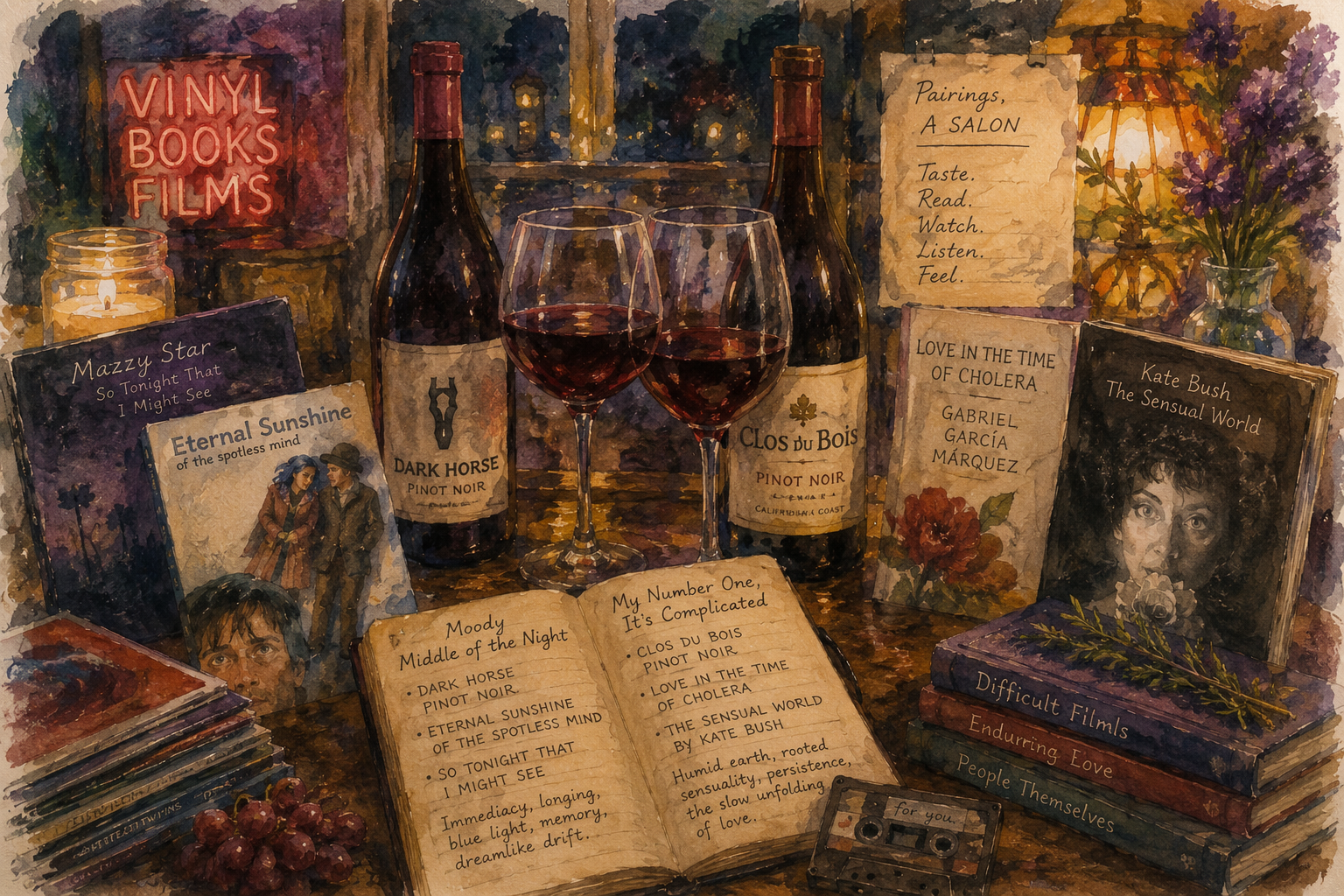
Moody Middle of the Night
WINE: Dark Horse Pinot Noir
MOVIE: Eternal Sunshine of the Spotless Mind
ALBUM: So Tonight That I Might See
This will serve you up a moody evening of immediacy, longing, blue light, memory, and dreamlike drift. From beginning to end, it will be holding you.
My Number One, It’s Complicated
But for even more complexity — for something like slipping slowly into a steaming hot bath, easing yourself in by degrees — I offer this:
WINE: Clos du Bois Pinot Noir
MOVIE AND BOOK: Love in the Time of Cholera
ALBUM: The Sensual World by Kate Bush.
Let the humid earth, rooted sensuality, bodies softening through time, moss, warmth, persistence, and the slow unfolding of love itself carry you through levels you hadn’t imagined.
May their complexities deepen your appreciation for the things and people you love.
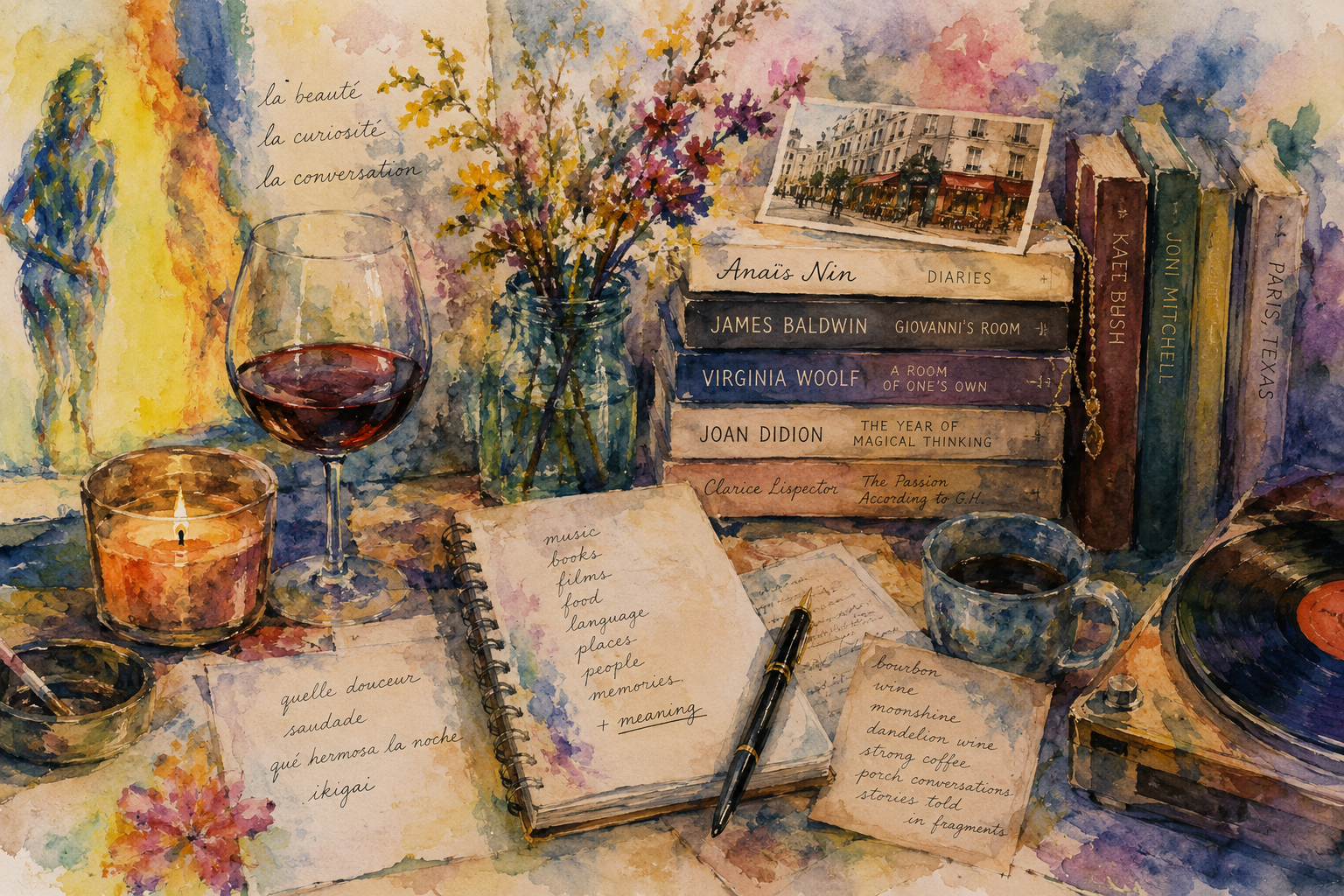
Art. Music. Literature. Film. Atmosphere. Conversation.
Pairings, A Salon, A Quest begins here
A gathering place for the culturally curious.
I imagine there was a time when people gathered for the sake of conversation.
Not performance.
Not branding.
Not outrage.
Not algorithms.
Not identity politics.
But conversation.
Music drifting from another room. A bottle of wine left open too long because someone paused mid-sentence to read a passage aloud. Cigarette smoke curling through old jazz records. Someone arguing passionately about a film no one else had seen. Someone else insisting you listen to the B-side. Books stacked beside bread and olives and coffee rings on wooden tables.
This salon began because I missed that world, a world I imagined, that I borrowed from movies and books and research.
Or perhaps because I spent years searching for it. Before I knew what niche interests were, I was skipping lunch to be in the library exploring mine. A guilty pleasure of mine? Fantasy books and encyclopedias of mythical animals like fairies, sprites, gnomes, and brownies. Didn’t all children dress their barbies up as woodland creatures and reenact The Dark Crystal and Labyrinth?
I tried book clubs. Gatherings. Small circles. But modern life is fragmented. Parenthood, schedules, exhaustion, economics, distance, politics, performance, rigidity. People became busy. Or guarded. Or afraid to wander intellectually beyond prescribed lanes.
Curiosity began to feel strangely rare.
And yet the hunger remained.
For atmosphere.
For sensuality paired with intelligence.
For people who still underline passages in books.
For conversations that roam.
For music that alters the emotional weather in a room.
For films that linger for years.
For multilingual fragments and candlelight and handwritten notes in margins.
So:
Pairings, A Salon
A place for correspondences.
Where Kate Bush may sit beside Anaïs Nin.
Where In the Mood for Love belongs beside rainstorms and cardamom tea.
Where Joni Mitchell meets motel stationery and open highways.
Where Paris, Texas hums beneath neon loneliness and desert skies.
Where James Baldwin, Susan Sontag, Joan Didion, Virginia Woolf, bell hooks, and Clarice Lispector still have seats at the table.
Some evenings may drift toward jazz.
Others toward French New Wave cinema.
Others toward gardens as emotional refuge.
Italian cinema paired with tomatoes, linen, olive oil, and late summer air.
Japanese ambient music beside winter rain.
Poetry folded into recipes.
Foreign phrases tucked gently into English like ribbons:
quelle douceur
saudade
qué hermosa la noche
ikigai
Not to posture.
Not to exclude.
But because language itself carries atmosphere.
And this is not a salon of exclusion.
It is a salon of fusion.
My own background is bourbon, wine, moonshine, and dandelion wine. Porch conversations. Strong coffee. Southern kitchens. Roadside diners. Flea markets. Working people. Coastal weather. Late-night music. Garden tomatoes. Stories told in fragments.
In the spirit of Anthony Bourdain and No Reservations, I believe culture expands at the table.
Not through perfection.
Not through elitism.
But through openness.
Bordeaux beside bourbon.
Moonshine beside espresso.
Opera beside folk songs.
Philosophy beside barbecue.
Hip hop beside poetry.
Appalachia beside Paris.
We are interested in correspondences, not hierarchies.
Bring your grandmother’s recipes.
Bring your favorite records.
Bring films that changed you.
Bring writers who haunted you.
Bring your languages.
Bring your strange little obsessions.
Bring your curiosity.
Curiosity is the passport here. Bring your Sesame Street references and your Russian techno and your love of Folk music and opera.
And perhaps, in a fragmented world, we can still create small evenings of meaning together.
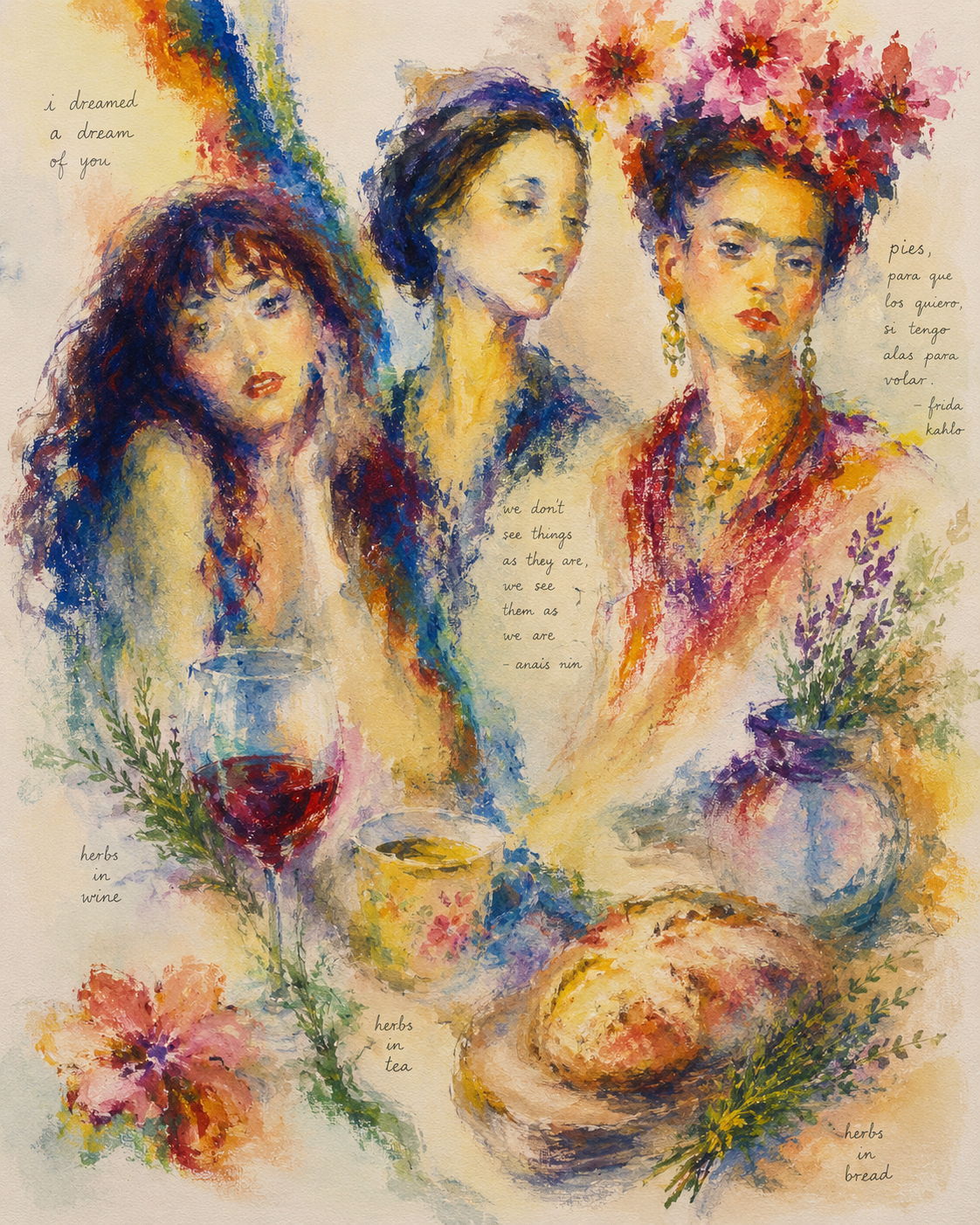
Kate Bush, Anaïs Nin, Frida Kahlo, and Herbs in Everything
Artists that share intimate interiors
On sensuality, survival, atmosphere, and the women who taught us to remain alive inside ourselves.
There are artists who do not simply create work.
They shared intimate interiors.
Rooms. Atmospheres. Emotional climates. Organs. Climaxes.
The kind of women whose presence lingers long after the record stops spinning or the final page closes. Women who understood that sensuality was never merely about seduction, but about aliveness. Attention. The ability to remain awake to beauty despite pain.
This pairing began, as many things do, with music drifting through another room.
Kate Bush singing from the kitchen speakers while herbs dried beside the stove. Mint hanging upside down from twine. Rosemary steeping in olive oil. Thyme pressed between fingertips. A loaf of bread warming slowly in the oven while evening light settled gold against the counters.
And suddenly there they were together.
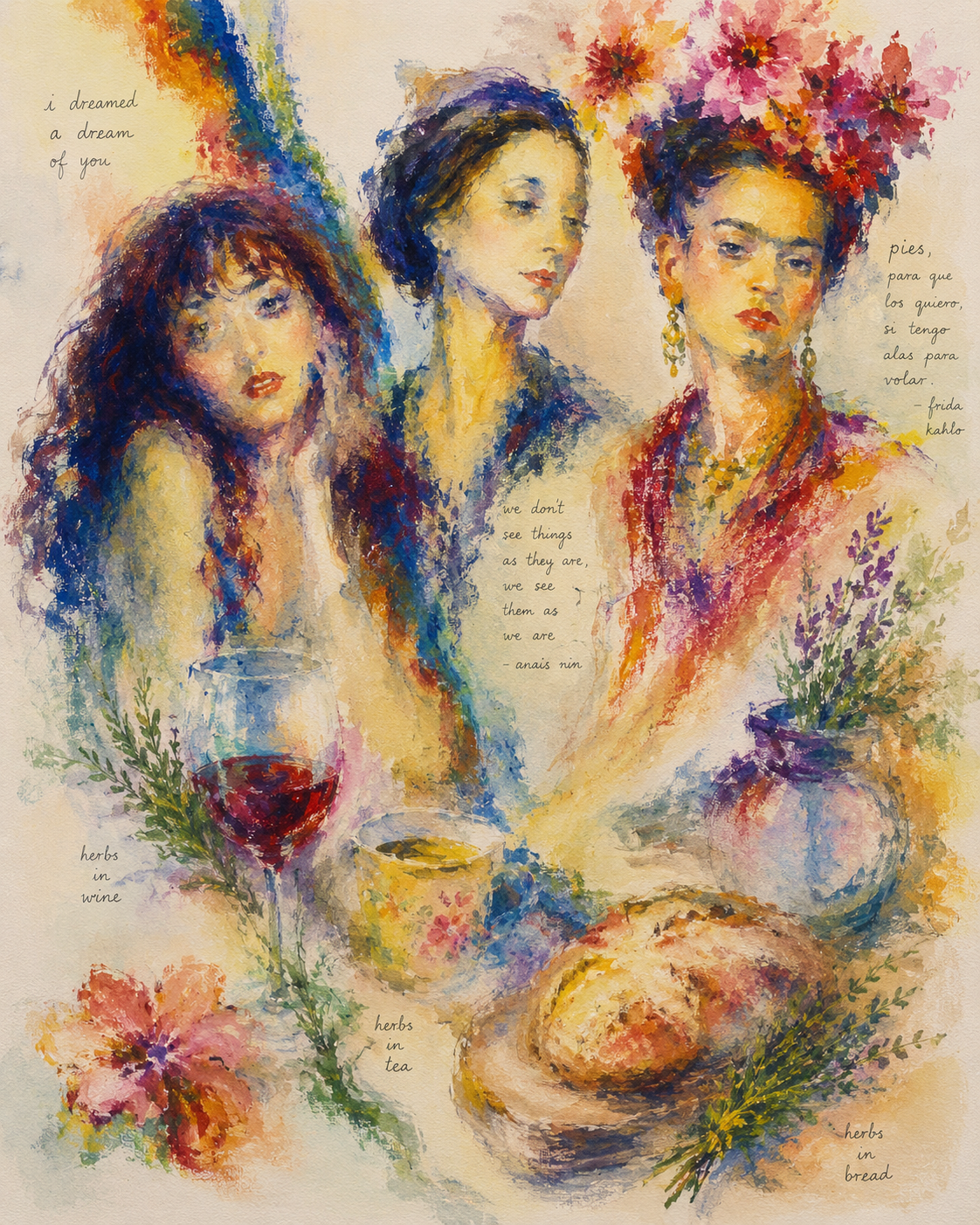
Kate Bush.
Anaïs Nin.
Frida Kahlo.
Three women who transformed interiority into art.
Not politely.
Not clinically.
Not from a distance.
But bodily.
Emotionally.
Spiritually.
Women who understood that atmosphere itself could become language.
Kate Bush turns emotion into weather systems. Listening to The Sensual World feels less like listening to music and more like wandering through hidden chambers of memory and feminine consciousness. Desire, longing, mythology, the sea, literature, the body — all folded together until they become almost tidal.
Anaïs Nin approached life similarly through language. Her diaries and essays were never merely records. They were excavations of the emotional interior. She treated sensuality as intelligence. Curiosity as survival.
And then there is Frida Kahlo.
Flowers woven into her hair like declarations. Color as resistance. Pain transformed into visual mythology. The domestic made sacred. The body refusing disappearance.
These women remind me that culture does not only live in museums or universities.
It lives in kitchens.
In gardens.
In ritual.
In how we prepare tea.
In what simmers slowly on the stove.
In the herbs we choose.
Mint in iced tea during summer heat.
Rosemary in wine sauces.
Lavender folded carefully into honey cakes.
Basil bruised gently beneath olive oil.
Thyme in bread.
Chamomile before sleep.
There is a reason herbs appear throughout old folklore and women’s traditions.
They were medicine.
Protection.
Flavor.
Atmosphere.
Memory.
A woman in her garden clipping rosemary with pink children’s scissors she picked up off the road from a walk while listening to Kate Bush, Bjork, The Cranberries … not revolutionary. Or maybe? ohh ohh ohh maybe…
But perhaps remaining sensitive in a brutalized trolling culture is revolutionary.
Perhaps continuing to cultivate beauty, taste, ritual, softness, curiosity, and emotional depth is its own quiet resistance.
Perhaps this is why I return to artists like these.
Not because they are perfect.
But because they refused numbness.
This is what Pairings, A Salon is interested in.
Correspondences.
How music belongs beside herbs.
How films belong beside weather.
How books belong beside meals.
How certain artists alter the emotional atmosphere of rooms.
How domestic spaces become creative sanctuaries.
How culture lives not only in galleries and journals, but in ordinary evenings.
Sensory. Sensual world. We were bodies first. We move through the world with nervous systems. Senses. First.
Tonight’s pairing:
Kate Bush on vinyl.
Anaïs Nin beside the bed.
Frida Kahlo flowers in a chipped ceramic vase.
Rosemary bread still warm.
Red wine breathing quietly nearby.
Mint steeping for later…
And somewhere beyond the windows, the world continuing noisily onward while small pockets of meaning are made anyway.
Quelle douceur…who sweet it is…life…
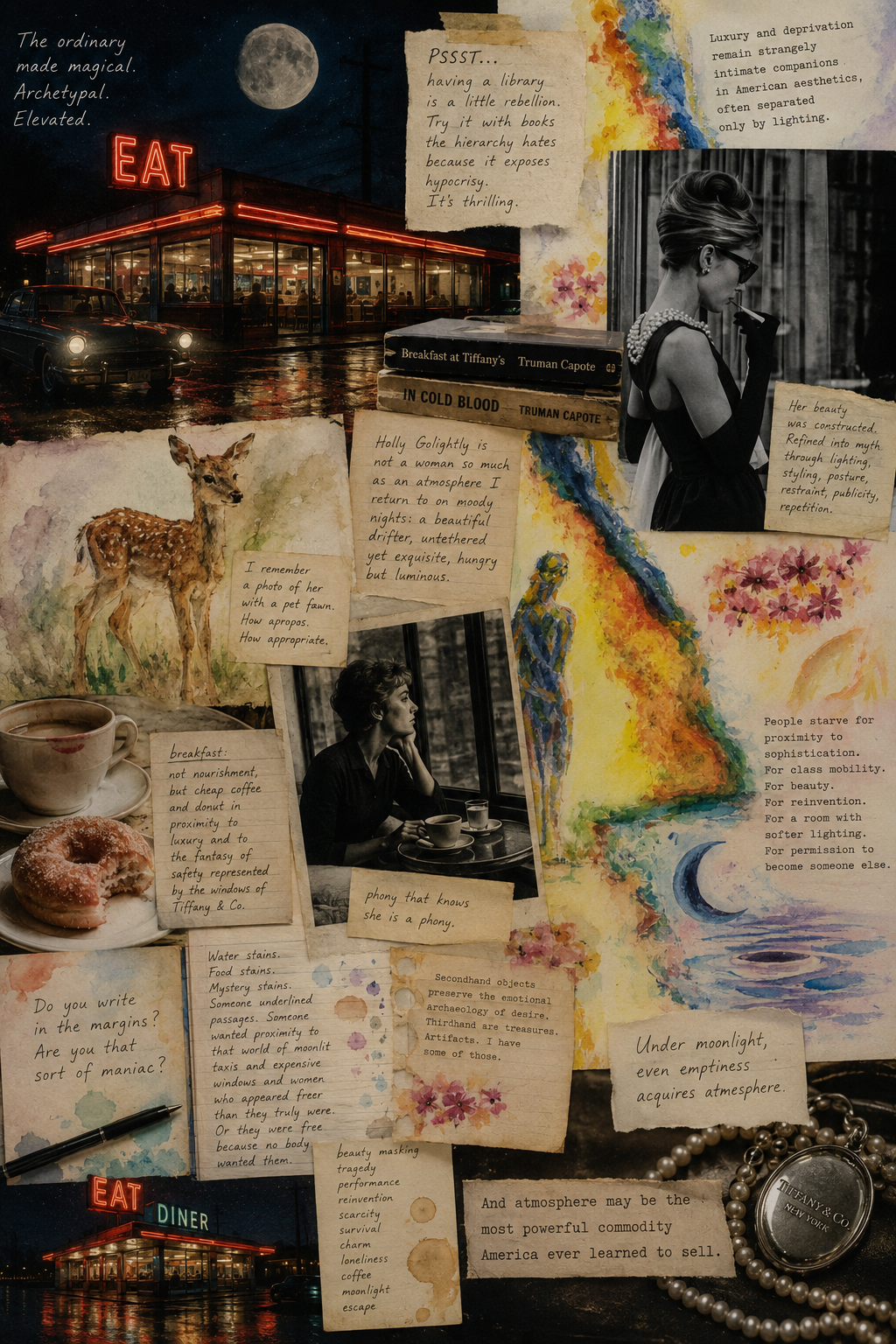
In Cold Blood at Tiffany’s and Starving Beauties
In Cold Blood at Breakfast at Tiffanys
There is something uniquely American about glamour built beside hunger.
Not merely physical hunger, though that remains threaded through the twentieth century image of femininity like cigarette smoke curling through a hotel bar. A more complicated starvation lives beneath it: emotional deprivation, aspirational longing, class performance, loneliness lacquered into elegance.
Truman Capote in my view understood this better.
That the same mind produced both Breakfast at Tiffany's and In Cold Blood feels less contradictory the longer one sits with it. One drifts through New York in dark glasses and Givenchy silhouettes, the other through the stark brutality of American violence, yet both are obsessed with performance, emptiness, desire, and the instability beneath polished surfaces.
Holly Golightly herself is less a woman than an atmosphere I return to, resurrecting for moody nights: she is a beautiful drifter, untethered yet exquisite, hungry but luminous, detached but secretly yearning for sanctuary. She survives through aesthetic intelligence but she is still young. Through her sort of charm, her ability to make herself a spectacle, a phony that knows she is a phony. We learn she is a creation of perpetual reinvention. Even breakfast is symbolic — it is not nourishment, but cheap coffee and donut in proximity to luxury and to the fantasy of safety represented by the windows of Tiffany & Co.
For me, the cultural mythology surrounding Audrey Hepburn complicated this further. Her image became synonymous with refinement so complete that fragility itself transformed into aspiration. Thin wrists, ballet flats, cigarettes held delicately between fingers, black coffee replacing appetite. Entire generations of women inherited the visual language almost unconsciously: elegance through restraint. Desire through absence.
I remember a photo of her with a pet fawn. How apropos. How appropriate.
But her beauty wasn’t natural.
Her beauty was constructed.
Refined into myth through lighting, styling, posture, restraint, publicity, repetition.
She became a symbol first of deprivation, then of self-imposed deprivation dressed up as elegance.
I wonder it Capote realized. He supposedly disliked her for the role. She I believe wanted to win him over. Lore or legend or real. I don’t know. But it fits. It makes sense.
By the 1990s, this aesthetic mutation hardened into something colder. “Heroin chic” converted visible exhaustion into editorial sophistication. Hollow cheeks, smeared eyeliner, sleepless glamour. Fashion photography flirted openly with deprivation while luxury branding sold the fantasy back at extraordinary prices. Beauty became increasingly tied to scarcity — lessness mistaken for refinement.
Yet starvation in American culture has never been purely bodily.
People starve for proximity to sophistication.
For class mobility.
For beauty.
For reinvention.
For a room with softer lighting.
For permission to become someone else.
This may explain the enduring emotional power of worn paperbacks found in thrift stores and give away donation boxes outside libraries clearing their dwindling stacks.
PSSST…. having a library is a little rebellion. Try it with books the hierarchy hates because it exposes hypocrisy. It’s thrilling.
A water-stained copy of Breakfast at Tiffany’s carries more than text. It carries traces of aspiration itself.
Do you write in the margins? Are you that sort of maniac?
Water stains. Food stains. Mystery stains. Someone underlined passages. Someone wanted proximity to that world of moonlit taxis and expensive windows and women who appeared freer than they truly were. Or they were free because no body wanted them.
Secondhand objects preserve the emotional archaeology of desire. Thirdhand are treasures. Artifacts. I have some of those.
The same nation that produced Tiffany blue boxes also produced roadside diners glowing beneath fluorescent exhaustion at two in the morning.
{PAUSE TO REMEMBER IT AND THE IMPACT OF SEEING IT LIKE NO ONE HAD SEEN IT BEFORE - THE ORDINARY MADE MAGICAL ARCHETYPAL ELEVATED}
The same culture that elevated polished femininity industrialized insecurity.
Luxury and deprivation remain strangely intimate companions in American aesthetics, often separated only by lighting. I’m thinking of a couple right off the top of our collective consciousness.
Perhaps this is why moon imagery persists so heavily around feminine glamour. Moonlight softens edges. Makes loneliness cinematic. Makes hunger appear poetic. Under moonlight, even emptiness acquires atmosphere.
And atmosphere may be the most powerful commodity America ever learned to sell.
Although we all know it winds up as second hand somewhere.
But, ah, thirdhand? Then it is a treasure.
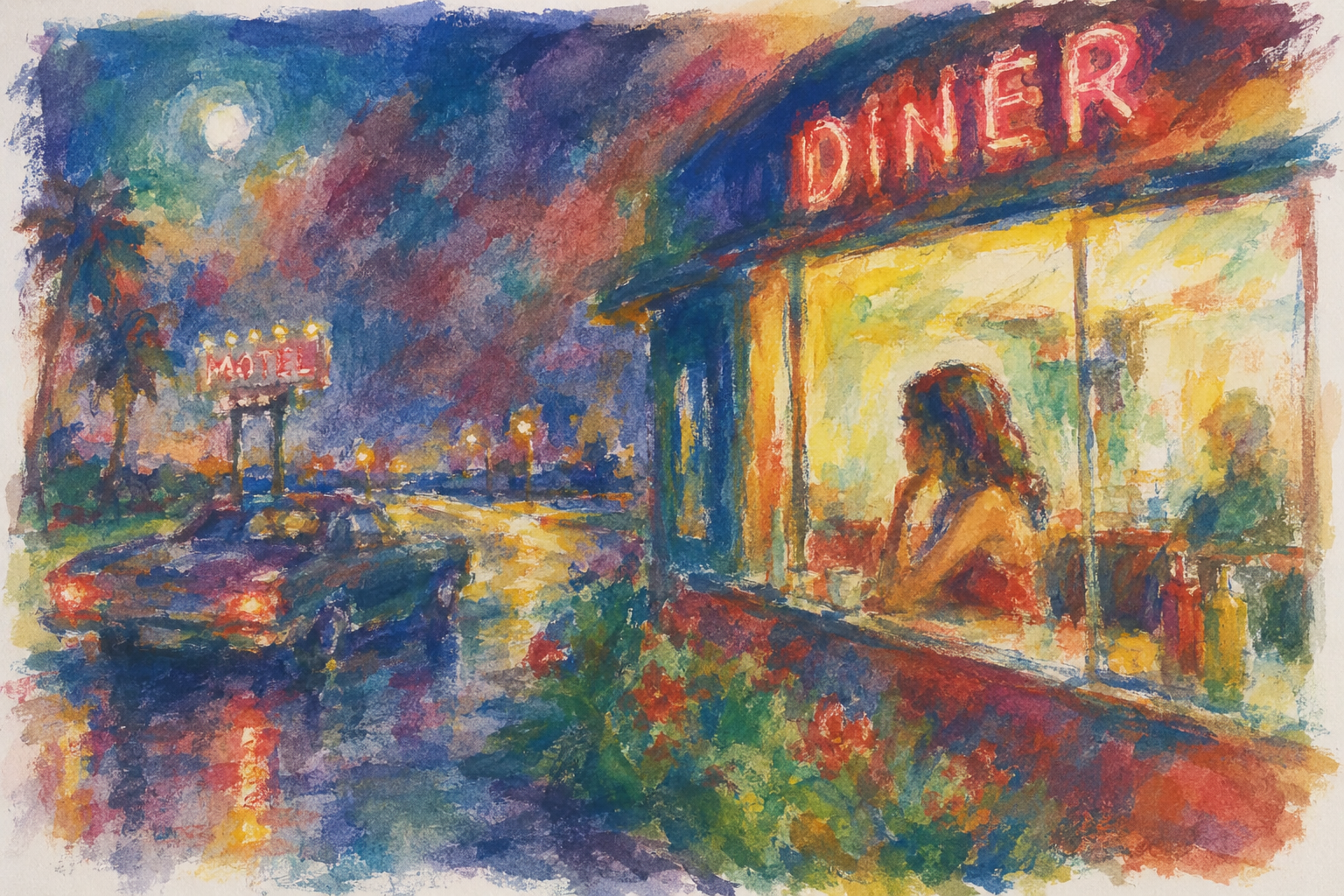
Roadside Glamour and the Loneliness of Neon
Roadside Glamorous
Edward Hopper, Lana Del Rey, diner coffee, motel rooms, and the American romance of almost getting somewhere.
There is a distinctly American melancholy that glows best beneath neon.
Not tragedy exactly.
Not failure either.
Something, not lonelier. I’ll say, more suspended.
A feeling of sitting beneath fluorescent light at 1:12 a.m. with diner coffee gone lukewarm, staring through a rain-streaked window as headlights pass somewhere beyond the glass. The feeling of motels beside highways. Cigarette smoke curling through parking lot sodium light. The romance of movement without arrival.
I see VAPE SHOP in neon capturing todays lost generation.
America has always aestheticized longing. I’d say it commodifies addictions.
If you asked me, I’d say we are in a capitalist spiral of make us sick make us well to make us sick again and don’t let government interfere with it.
Perhaps because ours is a nation built upon perpetual motion: westward expansion, reinvention, escape, the mythology of becoming someone else somewhere else. We worship the road even as it exhausts us. We romanticize departure while secretly craving home. We fantasize about colonizing other planets without even contemplating how surgery is complicated by the effects of gravity or how to recharge ships out in space. How do you have sex in space? How do you have artificial reproduction in space? What would the effects on the fetus be? (shivers internally…swims back to a lower atmosphere)
This is why Edward Hopper still feels contemporary. And comforting to me after my space dreams.
His paintings are not simply lonely. That is flat. They are emotionally suspended. Rooms hum … with absence? Diners glow like aquariums for the sleepless? the tired? the worn out? Women sit beside windows not doing anything dramatic at all — merely existing inside the unbearable quiet of being alive.
As someone who has lived past exhaustion, I know what is about to burst forth on the other side. Peace. The moment you let go.
The emotional architecture is what lingers for me.
Light spilling across countertops. Empty gas stations. Hotel rooms that feel temporary in every sense. Human beings positioned close to one another yet psychologically continents apart.
Human beings … positioned…together… yet psychologically and emotionally… worlds apart.
Lana Del Rey understands this visual language instinctively. She sells the illusion of attainable intimacy and communion but her lyrics? Dissolute. Distance. Depression. The morning after.
Her America is not patriotic myth so much as faded cinematic residue: motel pools, convertible rides at dusk, beauty queens dissolving beneath exhaustion, lipstick and melancholy coexisting in the same breath. The glamour matters precisely because it is fragile.
That fragility is the point.
The waitress topping off coffee beneath buzzing lights.
The woman applying lipstick by her reflection.
The couple driving somewhere or nowhere beneath an endless unrolling sky.
The lone figure at the diner counter after midnight.
These are not failures of American life. They are among its truest emotional images.
Roadside glamour fascinates because it sits at the intersection of hope and depletion. The country promises reinvention while quietly draining the people pursuing it. Yet somehow the neon still glows. Someone still pours another cup of coffee. Someone still drives toward another horizon believing life may yet change.
Almost getting somewhere becomes its own aesthetic.
And perhaps that is why diners feel oddly sacred in American consciousness. At least they use to? They seem to be becoming aesthetic and identity more than true America.
They were one of the last places where exhaustion, loneliness, hunger, class, glamour, heartbreak, truck drivers, students, old women, drifters, and insomniacs briefly coexist beneath the same soft electric light. Small democratic cathedrals of coffee and survival.
A place to pause without fully arriving.
A place to continue.
A place where even loneliness becomes cinematic for a moment.
Before developers knocked them down for Starbucks, Wawa, and whatever gray-paneled concept space came next.