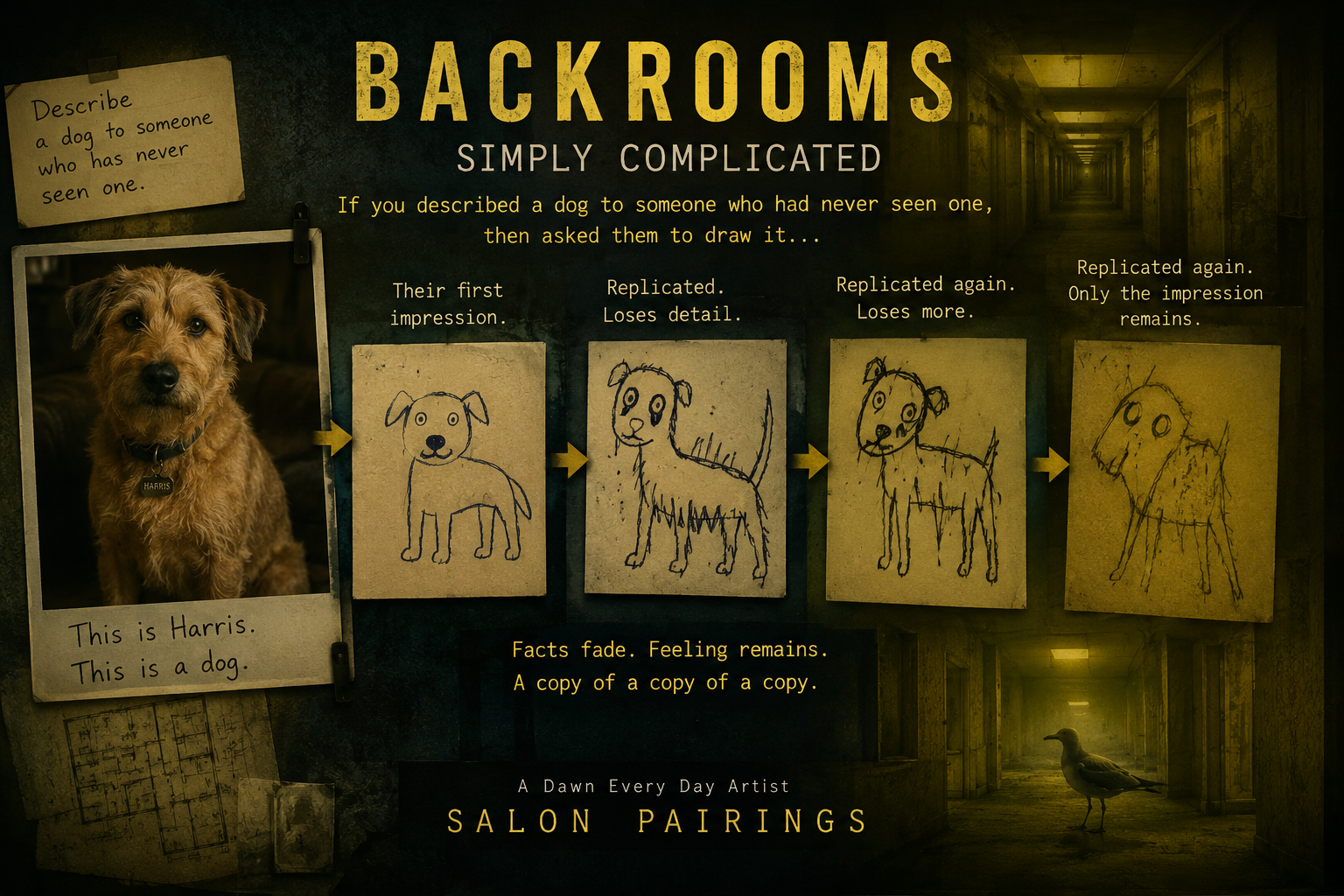
Backrooms: Simple. It’s Complicated.
There are movies that explain everything.
There are movies that explain nothing.
And then there are movies like Backrooms, which explain just enough to make you wonder if you understood any of it at all.
My son and I recently watched it together. We both agreed on the same review:
"Really good weird."
He applauded at the end and made me sit through the credits.
From him, that is a very high compliment.
At first glance, Backrooms appears to be a familiar horror story. Strange creatures lurk in endless corridors. Reality fractures. People become trapped in a place that should not exist. Probably a government experiment gone wrong. A Cold War accident.
But the longer I thought about it, the less interested I became in the monsters.
The rooms are copies.
The furniture is copied.
The stores are copied.
Dull. Lifeless. The worst kind of box-store furniture copies. D.O.A.
The hallways stretch on forever, reproducing themselves with dull persistence. Only the occasional M.C. Escher distortion saves the endless architecture from complete monotony.
Yet these things remain mostly lifeless.
A chair remains a chair.
A shelf remains a shelf.
A room remains a room.
The energetic distortions seem to happen when the Backrooms encounters people.
Not their bodies.
Their emotional impression.
Consider Captain Carl, or just Carl.
The phenomenon does not create an accurate version of Carl. Instead it appears to amplify something darker. Anger. Frustration. Resentment. Hunger.
The result is not a replica but a nightmare interpretation.
The same thing happens to the psychologist.
Her story is rooted in memories of her mother, isolation, mental illness, and a deteriorating apartment that was destined to disappear. As the film progresses, her memories seem to fragment and repeat. The details blur. The emotional weight remains.
By the end, what survives is not a factual recreation of her life.
It is an impression.
A posture.
A feeling.
A tired woman sitting in a kitchen.
Not reality.
Memory.
The more I considered it, the more I wondered if the Backrooms does not replicate objects at all.
Perhaps it replicates significance.
The phenomenon appears indifferent to furniture but fascinated by emotional energy.
Fear.
Grief.
Anger.
Despair.
The stronger the feeling, the more material it has to work with.
The resulting copies are inaccurate because memories themselves are inaccurate. We do not store our lives as perfect recordings. We store impressions. We remember emotions long after details disappear.
We remember what something felt like more than what it actually was like.
A childhood home can remain vivid while the actual floor plan becomes impossible to recall.
An argument can be forgotten while the hurt remains.
A person can vanish while the feeling they left behind survives for decades.
A radioactive shadow casting of emotion.
The Backrooms seems to operate according to similar logic.
Every copy drifts further from the original.
Every repetition loses information.
Every recreation becomes stranger.
Like a photocopy of a photocopy of a photocopy.
Until eventually only the emotional residue remains.
One small moment in the film captures this beautifully.
A seagull accidentally flies through an opening into the Backrooms.
It is not chosen.
It is not special.
It simply takes a wrong turn.
The bird crashes and dies much like birds sometimes fly into windows in our own world.
The scene is brief but unsettling.
It suggests the phenomenon is not targeting anyone.
It simply exists.
Reality has developed a leak.
Sometimes people fall through.
Sometimes birds do.
The universe is not angry.
The universe is not kind.
It is simply complicated.
And perhaps that is what lingers after the credits roll.
The monsters are frightening.
The hallways are strange.
But the deeper horror may be the possibility that memory itself is unstable.
That our strongest emotions survive while the facts dissolve around them.
That what remains of us is not an accurate record.
But a psychic impression.
An energetic feeling.
A story retold too many times.
Perhaps that is the true horror of Backrooms.
Not that we are forgotten.
But that what survives of us may not be the facts.
Only the feeling.
A psychic impression.
A radioactive shadow cast by memory.
A copy of a copy of a copy.
Simply complicated.
That’s what I think. Now you? What did you think? Simply terrible or something more than you gave it credit for?