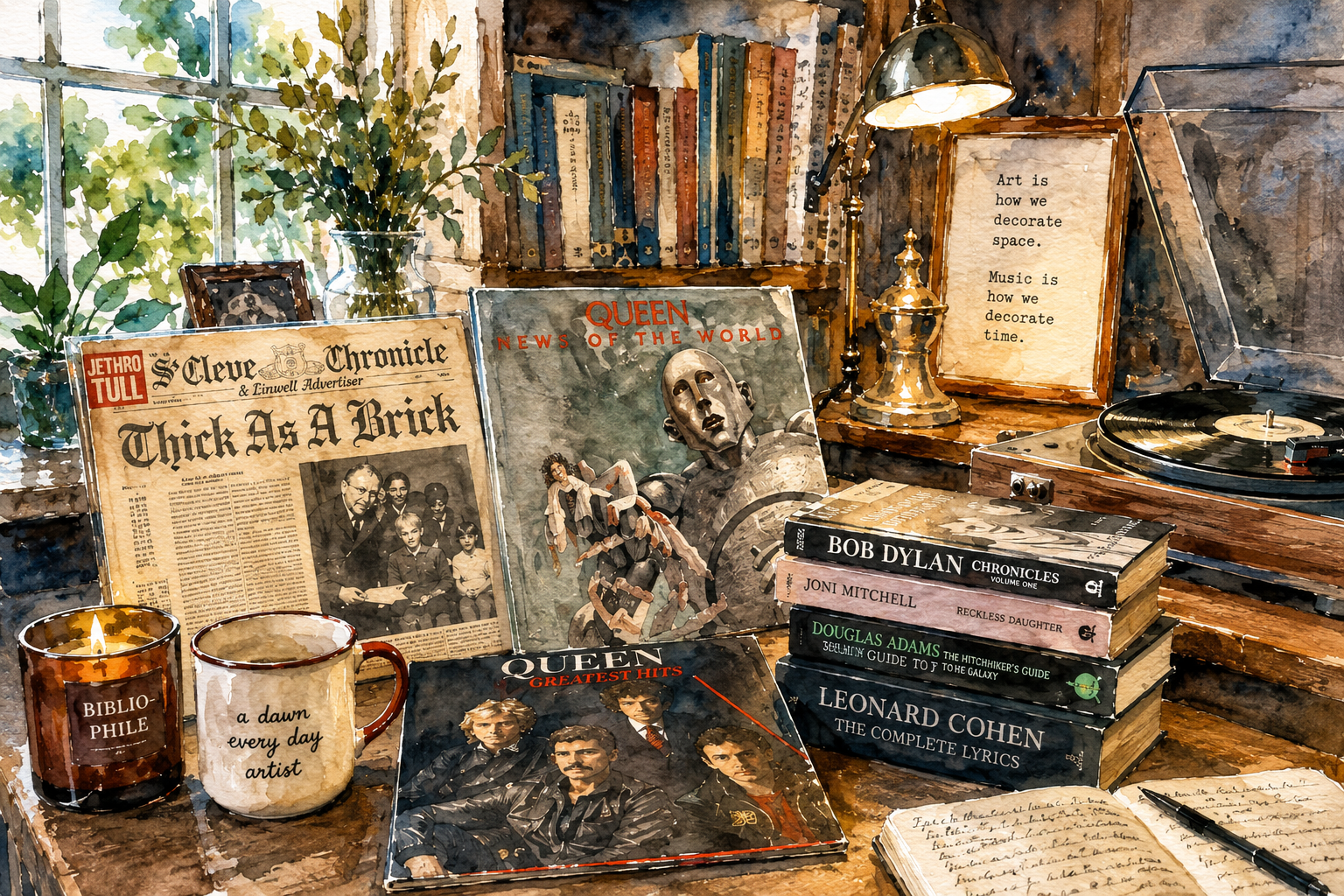
Curating Pressings and Prints
For some time now, I’ve wanted to curate a collection of vinyl, books, and art.
Not out of snobbery.
Not because I wanted the rarest editions or the most expensive shelves.
I wanted something intentional. Something I could have conversations about.
Someday, when my children stand in front of these shelves, I hope they don’t simply see things I accumulated. I hope they see a trail of curiosity. A record of questions. A collection built with care.
The problem was that I knew almost nothing.
How do you begin collecting something when you don’t know what matters?
I’ve been talked down to about art, music, and literature from two different directions—one elitist and the other supposedly grassroots.
In my experience, both voices were usually male. Condescending in different ways, but condescending all the same. It undermined my confidence more than I realized.
But regardless, I felt drawn to these things. I found myself asking the same questions over and over.
What do I want?
Why this artist?
Why this edition?
Why is one pressing twenty dollars while another is two hundred?
And perhaps the biggest question of all: Why does any of it matter?
For a while, the questions felt bigger than the collection.
Then, almost without noticing, a pattern emerged.
I wasn’t looking for popularity.
I wasn’t looking for obscurity either.
I wasn’t trying to own every classic album ever made.
I wasn’t trying to find something no one else had heard of.
I was looking for moments—and for what mattered to me personally.
Moments when an artist created something that shifted the conversation.
Moments that captured a season of culture.
Moments when someone was brave enough to make something unusual, ambitious, or beautifully strange.
One of the first records that really drew me in was Thick as a Brick by Jethro Tull.
I didn’t know Tull, although someone I knew was a big fan. Coincidentally, I also remembered seeing the name on cassette tapes in my husband’s kitchen when we first dated.
Instead of simply listening to the album, I researched it.
It was a parody. A joke. A jab at critics who had labeled the band’s previous album a “concept album.”
Ian Anderson was frustrated by that label.
His response seems to have been: Oh, you want a concept album?
Fine.
Here’s an absurdly elaborate fake newspaper wrapped around one impossibly long song.
They created the most outlandish, over-the-top concept album they could imagine, complete with a twelve-page newspaper cover. It was supposed to be a joke. The sandcastle man? Retired. The nonrabit? Found. A cross word puzzle. And advertisement. Sure.
Well, the joke backfired.
In trying to make the joke bigger, they created something great—something beloved and critically acclaimed. They were too good to fail? I don’t know. But it was a delicious and appealing story.
Finding the Monty Python connection sealed it.
Do you have any shrubbery?
I’m not dead yet.
The dead parrot sketch.
Yes. These were my people.
On a whim, I searched to see what an original pressing would cost.
And I stumbled upon one.
Near-mint condition. The elaborate newspaper foldout still intact.
It was too easy.
The price wasn’t outrageous. I expected some wear. I assumed the original sleeve hadn’t survived. I thought that if the record wasn’t scratched or warped, it was definitely worth grabbing.
I bought it.
It arrived in the mail, and it was more than I had hoped for.
Holding it felt different than streaming the music.
It felt like holding an idea.
Someone had imagined this wonderfully eccentric package and sent it into the world. The album wasn’t just music. It was storytelling, design, humor, and craftsmanship all working together.
Then came Queen.
First, A Night at the Opera—a near-mint original pressing and another piece of history.
Bohemian Rhapsody.
A song that refused to behave like an ordinary rock song. Opera, theater, camp, virtuosity, and complete commitment to an idea that shouldn’t have worked—but did.
Then News of the World.
We Will Rock You.
We Are the Champions.
Songs that somehow escaped their own era and became part of ours.
And then there was the artwork.
The enormous robot.
The theatricality.
The willingness to be strange, dramatic, and unapologetically imaginative.
Queen never seemed interested in staying in one lane. Rock, opera, music hall, theater, science fiction—they weren’t interested in being ordinary.
It wasn’t just an album.
It was evidence that creativity doesn’t always arrive quietly.
Sometimes it arrives wearing a cape.
I’m still learning.
Bob Dylan recently found his way onto my shelves, and I suspect many more artists will follow. Kate Bush I love. Will I collect her’s? Or Siouxsie and the Banshees? Blondie? Patti Smith? The Pretenders? Hole?
Some I’ll choose because history says they mattered.
Others because they simply speak to me.
Perhaps that’s the real lesson.
Curating isn’t about proving good taste. For everyone. I guess we have to qualify that. :)
For me, it’s about paying attention. And deepening that attention.
It’s about asking why something has endured.
Why it still makes people stop.
Why it makes ME stop.
Why it still deserves a place in the conversation.
It’s also about trusting my own eye, my own ear, and my own judgment.
And maybe, years from now, when one of my children pulls a record from the shelf or opens a well-loved book, they won’t just inherit an object.
They’ll inherit the questions that built the collection.
And, I hope, permission to ask their own.
To me, that’s worth preserving.