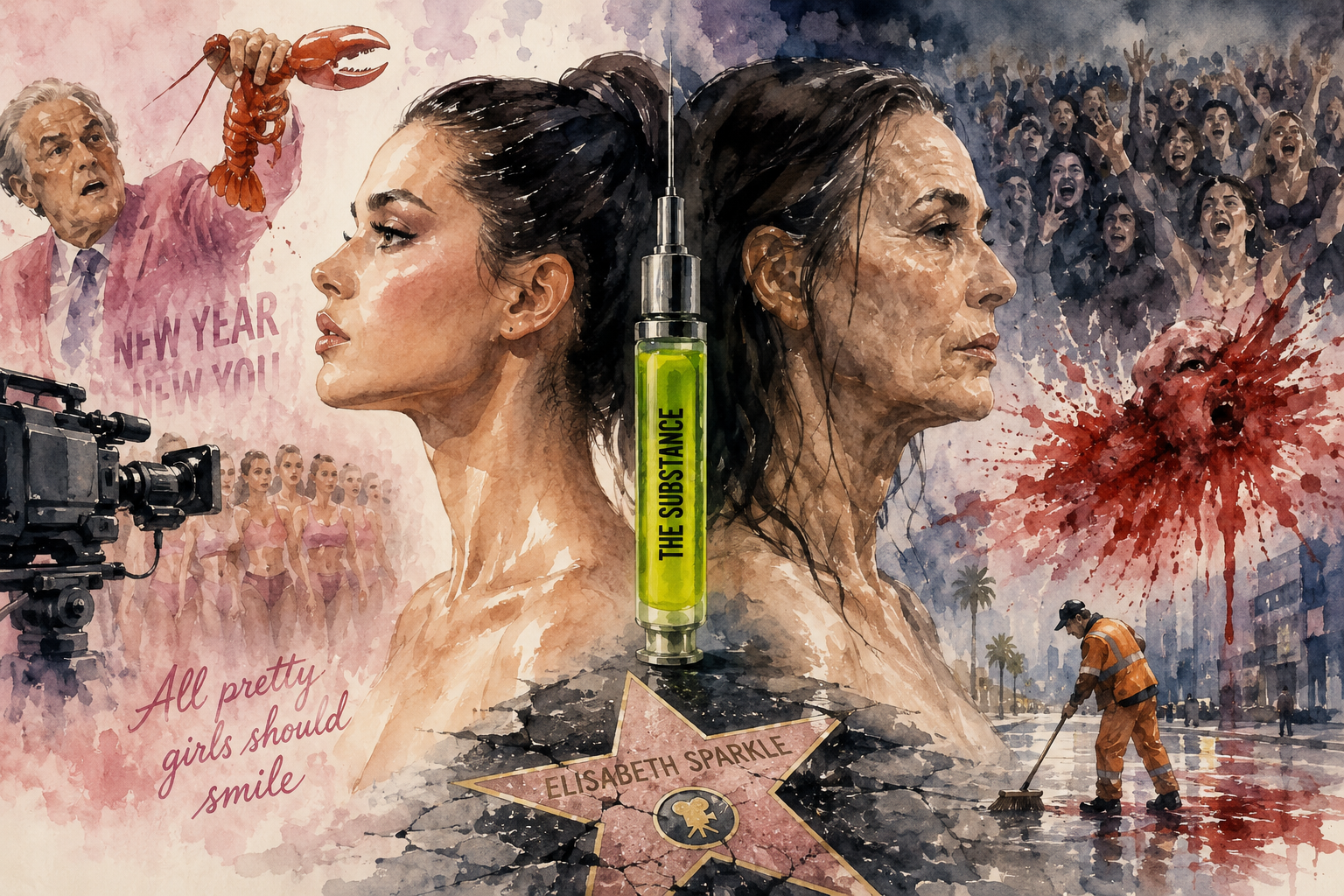
There is a moment while watching The Substance when I stopped asking what was happening to Elisabeth Sparkle and started asking what the film was doing to me.
At first, I thought the filmmakers simply didn't know when enough was enough.
Then I wondered if that was precisely the question they were asking the audience.
That shift changed the way I understood the film.
Most discussions of The Substance frame it as a satire about beauty standards, aging, and Hollywood. It is certainly those things. But I don't think beauty is its central concern. Beauty is simply the first imbalance. What the film ultimately explores is something much larger: a culture that has lost all sense of proportion.
A culture that has disregarded balance.
The premise is deceptively simple. Elisabeth Sparkle has built a career on being desirable. Let's not pretend the film is really about health, wellness, or even youth. It is about sex appeal—commodified, packaged, and sold.
Then she turns fifty.
The producer doesn't make this point with a thoughtful speech. He makes it while greedily tearing apart a seafood platter, gnashing through shellfish with almost animalistic enthusiasm. It is one of the film's first visual metaphors for appetite. Elisabeth watches him. She understands exactly what is happening. When he waves a limp crawdad in the air and says, "You know," many of us know exactly what he means.
She has lost her appeal.
Or, more precisely, she has reached the point where the industry believes she has topped out.
Being fifty myself, I almost laughed at the generosity. Depending on who you ask, Hollywood decided women were "over" at thirty... perhaps forty if they were lucky.
The tragedy isn't simply that Hollywood wants someone younger.
It's that Elisabeth doesn't want to leave.
Not yet.
Not ever.
Irreplaceable.
Like most of us, she doesn't want to disappear.
The film repeatedly reminds us that women are viewed in pieces rather than as whole people. The camera lingers on Sue's body the same way advertising does. Legs. Hips. Buttocks. Breasts. Slow motion. Fragmentation. The gaze itself becomes part of the story.
One of the film's most revealing moments comes when Sue suddenly demands a robe. She wants to cover herself. She finally experiences herself not as a woman preparing for work, but as an object assembled for someone else's visual consumption.
It is Elisabeth who still longs to hear the words every human being wants to hear.
We love you.
You are beautiful.
You could never be replaced.
That is different from wanting to be desired.
It is wanting to matter.
To be valued.
As Elisabeth creates Sue, the imbalance accelerates. It was always there, but now the film gives it a body.
Youth begins to hate age.
Age begins to hate youth.
The violence they inflict on one another becomes physical, but it represents something painfully recognizable: self-hatred born from impossible standards. Neither version can survive because each believes the other is stealing her life.
This is where the film's metaphor is at its strongest.
Then something curious happens.
The movie itself begins behaving like its own characters.
Every grotesque image is followed by something more grotesque.
Every mutation requires another mutation.
Every shocking moment demands something even bigger.
By the final act, I found myself wondering whether I had accidentally wandered into an entirely different movie. The ending carries the excess of the action films of the 1980s and 1990s, where body counts, explosions, and spectacle became competitions.
How many buckets of blood can we splatter?
The deformities become theatrical.
Whatever image the film introduces, it repeats, enlarges, and mutates until it becomes grotesque. Long before the detached breast hits the floor, I felt the metaphor had already landed.
I found myself asking what the filmmakers were doing.
(Okay... maybe it was more like, What the hell are they doing?!)
Then another possibility occurred to me.
Perhaps the film knows exactly what it is doing.
Perhaps it is asking the audience the same question it asks of Hollywood.
How much is enough?
How much beauty?
How much youth?
How much nudity?
How much gore?
How much spectacle?
At several points the movie feels as though it pauses, looks directly at the audience, and asks:
Still here?
Have I gone too far yet?
Did you get your ticket's worth?
If that is the intention, it is one of the film's cleverest ideas. It transforms the audience from observers into participants. We are no longer simply watching a story about consumption.
We are asked to examine our own appetite for excess.
The substance isn't merely the mysterious serum.
It is the substance of our desires.
The substance of entertainment.
The substance of celebrity.
The substance of consumption itself.
For me, the film made its point long before the gallons of blood. Yet I cannot dismiss the possibility that the excess is itself part of the argument. The film becomes as imbalanced as the world it depicts.
In the end, the monster dies.
Elisabeth's face crawls back to the Hollywood star that once bore her name. For a brief, almost heartbreaking moment, she imagines herself dusted in stardust rather than blood. She is loved. She belongs. She matters.
Morning comes.
A street cleaner washes her away.
The star remains.
Perhaps that is the final imbalance.
Hollywood preserves the symbol while erasing the person.
The performance survives.
The woman does not.
Please note, this is not a recommendation.
The only lasting thing I took from watching The Substance was the possibility that the filmmakers wanted us to finally reach a point where we turned away. To reject the spectacle. To decide that enough was enough.
If that was the experiment, it didn't work.
The film earned more than $80 million worldwide and received major awards recognition.
Or perhaps that, too, is part of the joke.
Even a film questioning our appetite for excess becomes another spectacle we consume.
I don’t think I really care for this version of Hollywood or entertainment. But I get the point. Perhaps I understand what film makers are trying to do. I just wish we didn’t live in a culture where this is the language we need to speak in order to be heard. Grotesque spectacle.
But it is the world we live in.